

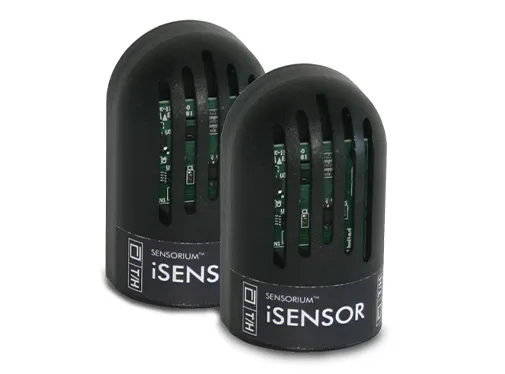
Carbon Dioxide (CO²) Sensor for iSensor & iAccess Controllers
Carbon Dioxide Sensor: Monitor and Alert CO² Levels
The Advanced DataCentre Systems iSensor Carbon Dioxide sensor works directly with iSensor and iAccess Controllers. The sensing element gathers three essential metrics: CO², temperature, and humidity. It also assess the air quality for infection risk protection.
You connect the sensor using standard CAT5/6 Ethernet cable via an available sensor port. This simple setup provides a proactive solution to monitor the environment in data centres and server rooms.
Product Overview
How the CO² Sensor Works in a Data Centre
In a data centre, managing air quality and environmental conditions is critical. A carbon dioxide (CO²) sensor constantly monitors air quality. Rising CO² levels warn operators: air is stale, or ventilation is failing.
Here is the process:
- The sensor uses Non-Dispersive Infrared (NDIR) light to count CO² molecules.
- It converts these counts into an electrical signal.
- The building control system instantly reads this signal.
- The system acts fast. It boosts ventilation or alerts staff immediately.
- Operators use this historical data to optimise airflow. This step reduces energy waste and stabilises the entire environment.
By knowing the exact CO² concentration, your data centre avoids overheating, manages humidity, and efficiently controls fresh-air intake. The sensor also uses the Wells-Riley model to assess infection risk.
Practical Uses of a CO² Sensor in Your Data Centre
A CO² sensor does more than just track air quality. It actively improves your environment and operations in several keyways:
- Smart Ventilation: Use Carbon Dioxide readings to adjust airflow dynamically, reducing waste and improving efficiency.
- Cut Energy Costs: Don’t waste power on constant full ventilation. Adjust your systems based on real CO² needs, only when necessary.
- Prevent Hotspots: High CO² often signals poor airflow. Detecting it helps you spot and fix airflow issues early.
- Meet Safety Standards: Ensure healthy air for everyone. Carbon Dioxide monitoring helps you meet safety regulations and health guidelines.
- Predictive Maintenance: Watch CO² trends over time. This helps you anticipate when ventilation or filters need attention, preventing breakdowns.
- Make Informed Choices: Use sensor data to guide improvements. Back your decisions for upgrades or system changes with solid facts.
- Infection Risk Protection: The sensor uses the Wells-Riley model to measure the risk of airborne infections.
Temperature & Humidity Monitoring
The iSensor CO² sensor tracks Carbon Dioxide levels. It also accurately monitors temperature and humidity. Tracking these key metrics helps detect early problems. It spots signs of overheating, moisture build-up, and other environmental shifts. These issues can impact your IT equipment’s performance, reliability, and lifespan.
You install the Carbon Dioxide iSensor using a CAT5/6 Ethernet cable. This setup is similar to the standard Temperature/Humidity sensor. You can place the iSensor up to 500 meters from an iAccess or iSensor Controller.
Monitoring all environmental conditions gives you a complete picture of your data centre. This includes tracking air particles. A full view lets you react quickly when conditions change.
Smart CO2 Monitoring: Beyond Air Quality
Our advanced CO² sensor does more than just measure gas levels; it actively evaluates air quality to estimate the real-time risk of airborne infection. By transforming raw data into actionable safety insights, you can protect personnel in even the most confined spaces.
How We Calculate Infection Risk: The Wells-Riley Model
To provide accurate safety data, the system utilises the Wells-Riley model. This proven mathematical framework assesses the probability of airborne disease transmission in shared indoor environments.The model calculates infection probability using several critical factors:
- Pathogen Exposure: The presence of airborne pathogens in a confined space.
- Ventilation Rates: How efficiently fresh air replaces contaminated air.
- CO² Levels: Used as a proxy to track air staleness and breath accumulation.
Our sensor integrates CO² data with ventilation rates and a disease-specific “dose-response constant.” This constant represents the likelihood of infection per unit of exposure. This can be tailored to address specific threats, such as COVID-19, Influenza or other airborne pathogens.
This is particularly critical in small communications rooms, where air conditioning and ventilation systems are often less robust than those found in full-scale data centres.
Installing and Maintaining Your Carbon Dioxide Sensor
Installation Steps
- Choose the right location — ideally where air circulates but away from direct airflow (vents) to get accurate readings.
- Mount securely: use the internal magnet to secure to the rack or metal object. Alternatively use other mounting methods as recommended by the manufacturer.
- Connect to a sensor port on the iAccess or iSensor Controller. The data can be managed via the on-board webserver or connected to your DCIM (Data Centre Infrastructure Management) or BMS (Building Management System.
- Once connected configure desired thresholds. If these are breached alerts will be issued.
Maintenance Tips
- Clean the Sensor: Dust and debris can affect readings — clean gently with a soft, dry cloth.
- Check Connections: Ensure power and data links remain stable, especially after physical work in the space.
- Review Data Trends: Regularly review Carbon Dioxide data to spot shifts or anomalies — this can also highlight sensor drift or faults.
- Calibration: Depending on your compliance or SLA requirements, periodic calibration may be necessary. Re-calibrate at intervals specified by the manufacturer to guarantee accuracy.
- Replace When Needed: Sensors have a lifespan. Replace them according to manufacturer guidance or when you notice persistent reading errors.
Features & Benefits
- Real-time CO² Monitoring — gives instant feedback on air quality.
- Proactive Monitoring — The sensor goes beyond monitoring carbon dioxide. It also constantly monitors temperature and humidity. This continuous tracking helps uncover early signs of overheating, moisture problems, or changing environmental conditions.
- Infection Risk Protection – Utilising the Wells-Riley model the sensor evaluates air quality and estimates infection risk for individuals in the space.
- Long Reach Cabling — Maximum Sensor cable length is 500 meters, using CAT5/6 Ethernet cable.
- Flexible Mounting — Each sensor comes with an internal magnet for easy mounting to the rack infrastructure.
- System Integration — Sensors connect directly to sensors ports on the iSensor and iAccess Controllers.
- High Accuracy IR Sensor — uses non-dispersive infrared (NDIR) technology to reliably detect Carbon Dioxide.
- Energy Efficiency — helps you fine-tune ventilation and reduce power waste.
- Safe Environment — ensures CO² stays within safe operational thresholds.
- Improved Airflow Management — detects poor airflow, temperature and humidity before it causes thermal issues or hotspots.
Specification
Carbon Dioxide (CO²)
- Range: 0~40000 ppm
- Accuracy: +/-50 ppm (400~2000 ppm)
- Repeatability: +/-10 ppm typ.
- Resolution: 16 bit.
Temperature
- Range: 0 to +123.8ºC (32 to +254.9°F)
- Response time: 5 to 30 seconds
- Accuracy: ±0.4 °C nominal
- Repeatability: ± 0.1 °C
- Resolution: 0.01 °C
Humidity
- Range: 0 to 100% Relative Humidity
- Response time: 8 Seconds in slow moving air @ 25 °C
- Stability: 0.5% RH per year
- Accuracy: ± 3.0% RH, 0-100% RH @ 25ºC
- Non-linearity: < 1% RH Typical
- Repeatability: ± 0.1% RH
- Resolution: 0.05 %RH
Frequently Asked Questions (FAQs)
What does the iSensor Carbon Dioxide Sensor monitor?
The iSensor Carbon Dioxide Sensor continuously measures:
- Carbon dioxide (CO2) concentration
- Temperature
- Relative humidity
- Infection Risk using the Wells-Riley model
These combined environmental readings provide real-time visibility of air quality and ventilation performance within data centres and server rooms.
Why is CO2 monitoring important in a data centre?
Rising CO2 levels typically indicate poor airflow or inadequate ventilation. Monitoring CO2 helps operators:
- Detect ventilation or airflow failures early
- Prevent thermal hotspots caused by stagnant air
- Maintain stable environmental conditions
- Optimise cooling efficiency
- Reduce unnecessary energy consumption
Accurate CO2 data allows facilities teams to adjust fresh-air intake dynamically rather than relying on fixed ventilation settings.
How does CO2 monitoring help prevent infection risk?
Carbon dioxide levels are widely used as an indicator of indoor air freshness and occupancy ventilation effectiveness.
Higher CO2 concentrations can suggest that exhaled air is accumulating in a space. Monitoring CO2 helps organisations:
- Identify poorly ventilated occupied areas
- Increase fresh-air exchange when needed
- Reduce airborne contaminant build-up
- Support healthier working environments for staff
This is particularly important in:
- Network Operations Centres (NOCs)
- Control rooms
- Edge data centres
- Occupied technical facilities
Maintaining good ventilation reduces airborne transmission risk in shared indoor environments.
What is the Wells-Riley model?
The Wells-Riley model is a simple model of the airborne transmission of infectious diseases, developed by William F. Wells and Richard L. Riley for tuberculosis and measles. Wells-Riley can also be applied to other diseases transmitted in the air, such as COVID-19.
How does the CO2 sensor work?
The sensor uses Non-Dispersive Infrared (NDIR) technology to measure carbon dioxide concentration by detecting CO2 molecules in the air.
The measured value is converted into a signal read instantly by the connected controller, enabling automatic alerts or ventilation adjustments when thresholds are exceeded.
Which controllers is the CO2 sensor compatible with?
The sensor connects directly to:
Environmental data can then be viewed locally or integrated into DCIM, BMS, or network monitoring platforms via SNMP.
How does CO2 monitoring improve energy efficiency?
Instead of running ventilation systems continuously at maximum capacity, CO2 monitoring enables demand-based ventilation.
This allows facilities teams to:
- Increase airflow only when required
- Reduce cooling and fan energy usage
- Optimise HVAC performance
- Lower operational costs
Historical CO2 trends can also highlight inefficient airflow or filtration issues.
Where should a CO2 sensor be installed?
For accurate readings, sensors should be installed:
- In areas with normal air circulation
- Away from direct airflow vents or exhausts
- Within occupied technical spaces
- Near racks or equipment zones affected by airflow
The integrated magnetic mount allows fast installation on rack infrastructure.
What CO2 levels are considered safe indoors?
Typical indoor guidance levels are:
- 400–800 ppm: Excellent air quality
- 800–1,000 ppm: Acceptable ventilation
- 1,000+ ppm: Ventilation improvement recommended
- 2,000+ ppm: Poor air quality requiring action
Configurable alarms allow operators to respond before conditions affect personnel comfort or operational stability.
Can alerts be generated when CO2 levels rise?
Yes. Custom thresholds can be configured through the connected controller.
When limits are exceeded, automated alerts can be triggered via:
- Email notifications
- SNMP traps
- DCIM or BMS alarms
This enables immediate corrective action.
How does CO2 monitoring support predictive maintenance?
Long-term CO2 trend analysis helps identify:
- Failing ventilation systems
- Blocked filters
- Airflow imbalance
- Cooling inefficiencies
Early detection allows maintenance teams to intervene before environmental issues impact IT equipment performance.
Does the sensor require maintenance or calibration?
Minimal maintenance is required. Recommended best practices include:
- Periodic cleaning to prevent dust interference
- Reviewing environmental trend data
- Calibration in line with compliance or SLA requirements
Routine checks ensure long-term measurement accuracy.
Get in touch today
To learn more about Volt Free Contact sensors or to discuss a requirement, please contact us.