

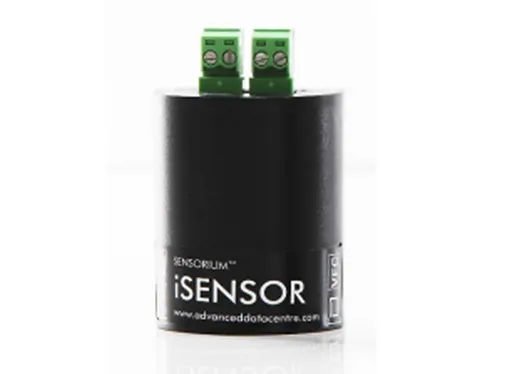
iSensor Volt Free Contact (VFC) for iSensor & iAccess Controllers
Volt Free Contact Sensor: Monitor and Alert Open/Close Devices
The Advanced Datacentre Systems iSensor Volt Free Contact (VFC) helps you monitor devices. To enhance security auditing, this optional sensor tracks the physical open/close state of contacts. Instantly flagging potential issues within the data centre.
This sensor sends simple open or closed signals to your monitoring software. You can connect it to platforms like:
- NMS (Network Management Systems)
- BMS (Building Management Systems)
- DCIM (Data Centre Infrastructure Management)
Use it to check if a door is open, a switch is on/off, or a breaker has tripped.
Learn more about Environmental Monitoring by reading our Essential Guide to Environmental Monitoring in Data Centres.
Product Overview
What Is the iSensor Volt-Free Contact (VFC)?
The iSensor Volt-Free Contact (VFC) is a simple, reliable sensor that functions as a voltage-independent, mechanical switch. Unlike a traditional switch, it does not generate electrical power. Instead, this smart device makes it easy to share information. It sends updates about whether circuits are open or closed. This information goes straight to your IT, facility, or data centre systems. It uses standard communication methods that all these systems understand.
Our “dry contact” design solves a common problem. It stops voltage differences from causing issues. This means you can easily connect it to your existing systems. It works with management platforms like NMS, BMS, and DCIM.
How Does the VFC Work?
The VFC connects to an iSensor or iAccess controller with a standard CAT 5/6 Ethernet cable. You can use cable runs up to 500 metres, which gives you plenty of installation options. The device uses a basic mechanical switching action. When a door opens, a panel triggers, or a linked system changes state, the contact either closes or opens. The controller reads this change and sends the event to your chosen platform.
You can set the device as Normally Open (NO) or Normally Closed (NC). This helps you match the sensor to different operational needs. The VFC also includes a 100ms anti-bounce time. This short delay stops rapid flickering of the switch from creating false alerts.
The VFC gives you a safe and isolated connection point. Because the contact is “volt-free,” it never introduces voltage into a circuit. You supply the voltage that drives the signal. This protects your systems from electrical conflicts and makes the VFC suitable for a wide range of equipment. Many teams choose dry contacts because they reduce risk, keep wiring simple and help avoid interference between systems.
Built for Real-World Data Centre Needs
Data centres rely on accurate and fast signalling. The VFC sensor supports this by keeping its design simple and robust. It uses an RS485 interface at 9600 baud rate, with an 8 data-bits, 1 stop bit, no parity configuration. This keeps communication stable and predictable. The device also runs on very low power: 5 V DC at 100 mA, with an internal 3.3 V supply that draws only 50 mA. This reduces heat, keeps energy use low and helps ensure long-term reliability.
Where You Can Use VFC Sensors
Facility teams often use the VFC sensors to track door contacts, security panels, equipment alarms, airflow switches, power events and many other binary signals. Because the device offers complete electrical isolation, it suits almost any system that outputs an open/close contact. You can also integrate it into safety systems, interlocks, threshold triggers or backup equipment.
Why Dry Contacts Help
The VFC iSensor converts simple dry contact inputs into clear, actionable data.
You gain instant visibility of critical events. This setup lets you spot problems early and maintain strict control. The VFC scales with ease, supporting long cable runs and flexible mounting options. Simple wiring ensures high compatibility. Deploy it immediately into any existing system.
Features & Benefits
- Connects via standard CAT 5/6 Ethernet cable
- Supports up to 500 metres of sensor cable
- Offers Normally Open (NO) or Normally Closed (NC) contact types
- Anti-bounce time of 100ms to reduce false triggers
- Maximum contact resistance: 2 kΩ
- Uses RS485 interface with 9600 baud, 8 data bits, 1 stop bit, no parity
- Compatible with both iSensor and iAccess controllers
- Requires only 5 V DC at 100 mA (very low power)
- Internal 3.3 V supply draws just 50 mA
- Provides isolated, “dry contact” switching for safe integration
Specification
Contact Inputs
- Type: Normally Open (N.O) or Normally Closed (N.C)
- Anti-bounce time: 100 mS
- Contact Resistance: 2k ohms max.
iSensor Port
- Interface: RS485
- Protocol: 9600 baud, 8 data bits, 1 stop bit, no parity
- Compatibility: iSensor & iAccess Controllers
DC Characteristics
- 5V Supply: 5 VDC @ 100 mAmps max
- 3.3V internal supply: 3.3 VDC @ 50 mAmps max
Frequently Asked Questions (FAQs)
What is a volt free contact?
A volt free contact (also known as a dry contact or potential-free contact) is a simple switch or relay output that does not supply any voltage itself. Instead, it opens or closes a circuit using an external power source.
What is a volt free contact used for?
Volt free contacts are commonly used to:
- Signal alarms or system status
- Integrate equipment with BMS (Building Management Systems)
- Monitor UPS, HVAC, fire systems, and security systems
- Trigger alerts or automation workflows
They allow safe communication between different systems without electrical interference.
Why are volt free contacts important in data centres?
In data centre environments, volt free contacts provide:
- Safe isolation between systems
- Reliable monitoring of critical equipment
- Compatibility with third-party systems
- Low-risk signalling for alarms and events
This makes them ideal for integrating multiple hardware components into a unified monitoring system.
What is the difference between volt free (dry) and wet contacts?
- Volt free (dry contact): No voltage is provided — requires an external power source
- Wet contact: Voltage is supplied directly from the device
Dry contacts are preferred where isolation and flexibility are required.
How does a volt free contact work?
A volt free contact works like a basic switch:
- When open → no current flows
- When closed → current flows (from an external source)
It simply makes or breaks a circuit without introducing its own voltage.
What types of volt free contacts are available?
The most common types are:
- Normally Open (NO) – circuit is open until activated
- Normally Closed (NC) – circuit is closed until activated
- Changeover (NO/NC combined) – switches between states
Are volt free contacts compatible with all systems?
Yes — one of the main advantages is their universal compatibility. Because they don’t carry voltage, they can interface with:
- Different voltage systems
- Third-party equipment
- Legacy and modern infrastructure
What equipment typically provides volt free contacts?
Volt free contacts are found in:
- UPS systems
- CRAC / cooling units
- Fire alarm panels
- Environmental monitoring systems
- Power distribution units (PDUs)
Can volt free contacts carry power?
No — volt free contacts do not carry or generate power themselves. They only act as a switching mechanism. The connected circuit must provide its own voltage.
What are the benefits of using volt free contacts?
- Electrical isolation (safer integration)
- Flexible system compatibility
- Simple and reliable operation
- Ideal for monitoring and alarms
- Reduced risk of damage from voltage mismatch
Do I need specialist installation?
While volt free contacts are simple in concept, installation should be carried out by a qualified engineer or technician, especially in critical environments like data centres.
Can volt free contacts be used for remote monitoring?
Yes — they are widely used for remote monitoring. When connected to the iSensor Controller, they can:
- Trigger alerts
- Send notifications
- Integrate with DCIM or BMS systems
Get in touch today
To learn more about Volt Free Contact sensors or to discuss a requirement, please contact us.