

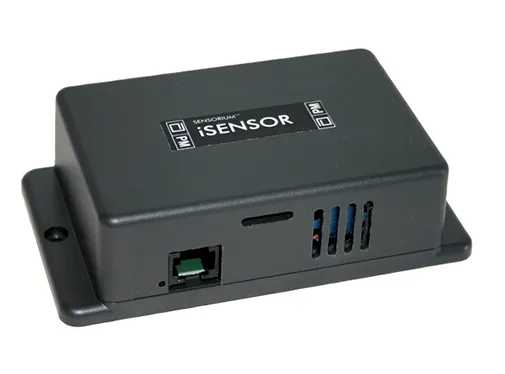
Particle Sensor for iSensor & iAccess Controllers
Data Centre Air Quality Air Particle Sensor
The Advanced Datacentre Systems iSensor Particle Sensor is an optional component for your setup. It actively detects and counts particulate matter (PM) present in the air.
This sensor then measures the particles’ specific density and size, relaying all that information to your connected iSensor or iAccess Controller.
Learn more about Environmental Monitoring by reading our Essential Guide to Environmental Monitoring in Data Centres.
Product Overview
What Is the iSensor Particle Sensor?
The iSensor Particle Sensor gives you clear insight into the air quality inside your data centre or server room. It tracks particles of different sizes and reports real-time data to your iSensor or iAccess Controller.
With this information, you can make fast decisions and keep your critical equipment safe.
Why Air Quality Matters in Data Centres?
Clean air plays a major role in the health of IT hardware. Dust, smoke, and fine particles settle on circuit boards, fans, and cooling components. Over time, this build-up reduces airflow, raises temperatures, and increases the risk of equipment failure.
By monitoring particle levels, you remove guesswork. You know when conditions change, why they change, and what you need to do next. Strong air-quality control also helps reduce maintenance costs, improve uptime, and extend the life of your IT equipment.
What the Sensor Measures
The sensor tracks three key particulate groups:
- PM1.0: Very fine particles that can reach sensitive internal components
- PM2.5: Common airborne pollutants that affect cooling and airflow
- PM10: Larger dust and debris that settle on hardware surfaces
These readings give you a full picture of the air around your equipment. You can see trends, respond to spikes, and plan maintenance at the right time.
Fast, Accurate, Real-Time Monitoring
The sensor delivers fast updates so you can act before an issue becomes a risk. It provides:
- High counting accuracy across all particle sizes
- Clear measurements in micrograms per cubic metre (µg/m³)
- Rapid response times for both single and aggregated readings
This speed and accuracy help you maintain a stable and predictable environment.
Simple Installation & Integration
The sensor connects directly to your iSensor or iAccess Controller using standard CAT5 or CAT6 cabling. Once connected, it begins sending live data without complicated setup. You can view particle counts, set alerts, and track trends through your existing monitoring system.
This plug-and-play approach helps you expand your environmental monitoring without extra hardware or specialist tools.
Benefits for Your Facility
When you add particle monitoring to your data centre, you gain several advantages:
- Better protection for servers, switches, and storage
- Early detection of dust ingress, smoke, or HVAC issues
- More predictable maintenance and cleaning schedules
- Support for environmental and compliance standards
- Improved overall reliability of your infrastructure
These benefits make particle monitoring a smart upgrade for facilities of any size.
Typical Applications
The sensor works well in many environments, including:
- Data centres and server rooms
- Network closets or comms rooms
- Clean rooms and controlled facilities
- Industrial sites that require accurate particulate tracking
Any space where air quality affects performance or safety.
Features & Benefits
The optional iSensor Particle Sensor connects to sensor ports on iSensor or iAccess Controllers.
- Counts particulate matter (PM) in air.
- Reports particle density and size to controller.
- Measures PM in these ranges:
- 3–1.0 µm (PM1.0)
- 0–2.5 µm (PM2.5)
- 5–10 µm (PM10)
- Uses standard CAT5/6 Ethernet cabling for connection.
Provides active, real-time monitoring of air quality in data centres or server rooms
Specification
Ranges
- 0.3-1.0um (PM1.0)
- 1.0-2.5um (PM2.5)
- 2.5-10um (PM10)
Count Efficiency
- 50% @ 0.3um
- 98% @ >= 0.5um
- Effective Range: 0-500ug/m3
- Maximum range: 1000ug/m3
- Resolution: 1ug/m3
- Consistency Error: +/- 10% @ 100-500ug/m3
- Response Time:
- < 1 second (Single)
- <= 10 seconds (total)
Frequently Asked Questions (FAQs)
What is a particle sensor in a data centre?
A particle sensor is a device that monitors airborne particulate matter such as dust, smoke, and pollutants within a data centre environment. It detects and measures particle size and concentration (e.g. PM1.0, PM2.5, PM10) to help maintain clean air and protect critical IT equipment.
Why is air quality important in data centres?
Air quality directly impacts the performance and lifespan of IT hardware. Dust and fine particles can accumulate on components, restrict airflow, increase temperatures, and lead to equipment failure. Monitoring air quality helps reduce downtime and improve reliability.
What types of particles do data centre sensors detect?
Most data centre particle sensors monitor three key particulate sizes:
- PM1.0 – ultra-fine particles that penetrate sensitive components
- PM2.5 – fine particles that affect cooling and airflow
- PM10 – larger dust particles that settle on equipment
These measurements provide a complete picture of environmental conditions.
How does a particle sensor work?
Particle sensors typically use optical or laser-based detection methods to measure airborne particles. As particles pass through a light beam, they scatter light, allowing the sensor to count and size them in real time.
What are the benefits of installing a particle sensor in a server room?
Installing a particle sensor provides several benefits:
- Real-time air quality monitoring
- Early detection of dust, smoke, or contamination
- Reduced maintenance costs
- Improved uptime and system reliability
- Extended lifespan of IT equipment
Can particle sensors help prevent data centre downtime?
Yes. Airborne contamination is a major but often overlooked cause of downtime. By detecting changes in particle levels early, operators can take proactive action before issues impact performance or cause failures.
Where should particle sensors be installed in a data centre?
Particle sensors are typically installed in key airflow areas such as:
- Near server racks
- In cooling aisles (hot/cold aisles)
- Air intake points
- Ceiling or raised floor zones
This ensures accurate monitoring of contamination risks throughout the facility.
How do particle sensors integrate with monitoring systems?
The iSensor particle sensor connects directly to the iSensor Controller environmental monitoring system. The controller then integrates to DCIM or other management platforms. They provide real-time data, alerts, and trend analysis, allowing operators to respond quickly to environmental changes.
What industries use particle sensors besides data centres?
Particle sensors are widely used in industries where clean environments are critical, including:
- Semiconductor manufacturing
- Pharmaceuticals and healthcare
- Cleanrooms and laboratories
- Industrial processing facilities
Are particle sensors required for compliance standards?
While not always mandatory, particle monitoring helps data centres meet air cleanliness standards such as ISO 14644. Maintaining these standards supports operational efficiency and reduces risk.
Get in touch today
To learn more about iSensor Particle Sensor or to discuss a requirement, please contact us.