

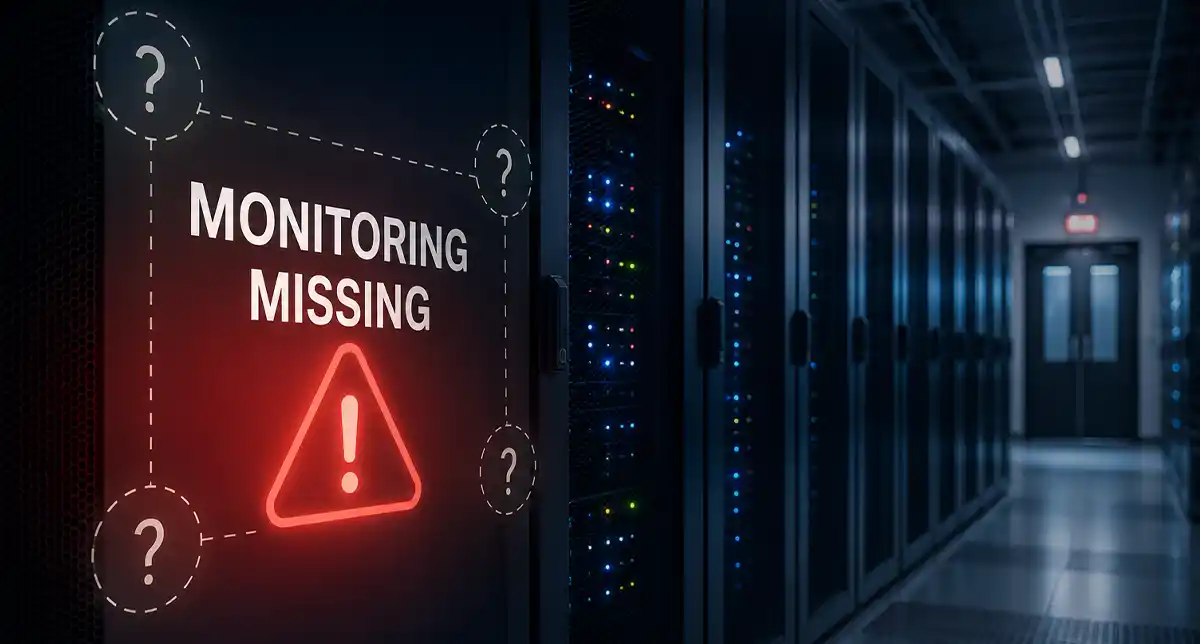
Data centres need stable environmental conditions, but operators can only manage what they can see.
When a facility has no environmental monitoring at all, the risks are easy to see: temperature spikes, humidity drift, and equipment running outside its optimal range can happen unnoticed.
The real difficulty arises when monitoring is partial, not absent. A room thermostat, a handful of sensors, or alerts from individual cooling units may exist, yet significant coverage gaps remain.
These gaps create a false sense of security. The dashboard may show everything is normal, while the actual conditions around individual racks, aisles, or pieces of equipment tell a different story.
Consequently, monitoring gaps do more than hide information. They shrink the window for response, complicate incident investigations, and force operators to rely on assumptions instead of evidence.
Monitoring Can Be Present and Still Be Incomplete
Choosing whether to monitor or not to monitor is rarely a simple decision. Many facilities gather environmental data yet still miss the conditions that matter most.
For example, a data centre may collect some information while overlooking critical factors such as:
- Monitoring the room but not individual racks
- Measuring temperature without tracking humidity
- Relying on readings from cooling equipment rather than the IT environment
- Using sensors that do not trigger automatic alerts
- Collecting live readings without storing historical trends
- Monitoring one data hall while leaving plant rooms or remote sites uncovered
- Using separate systems that cannot share information
- Failing to update sensor coverage after racks or equipment move
Consequently, the organisation ends up with a monitoring blind spot—an area, condition, or event that can change unnoticed. This blind spot arises because the collected data does not provide a complete picture of what is happening throughout the facility.
Localised Hotspots Can Develop Unnoticed
A room level temperature sensor reports the average condition of the space it occupies, but it does not show what occurs inside each individual rack.
Changes in equipment density, blocked airflow, missing blanking panels, or altered floor tiles can create hot spots within the room. Consequently, a rack may start pulling in warmer air even though the overall room temperature stays within acceptable limits.
If operators do not place sensors close to the equipment, they may miss these temperature rises until one of the following events occurs:
- Server fans begin working harder
- Equipment performance drops
- Thermal alarms trigger
- Hardware shuts down
- Users experience a service interruption
By the time an alarm sounds, the underlying environmental issue may already have progressed significantly.
Rack level environmental monitoring solves this problem. It gives operators an early warning, allowing them to spot temperature changes at each rack before the IT equipment reaches a critical state.
Humidity Changes Remain Invisible
Organisations usually begin by measuring temperature, but that reading alone does not tell the whole story.
When humidity rises too much, condensation and corrosion become more likely; when it drops too low, the chance of electrostatic discharge spikes. Neither problem is obvious during a routine walk‑through, so a data hall can look fine even as moisture drifts outside the preferred range.
Because temperature‑only monitoring misses these hidden shifts, operators may think a room is cool enough while unaware that the air around sensitive equipment is becoming too damp or too dry.
By tracking temperature and humidity together, teams gain a fuller picture of the environment and can act early—before changing conditions threaten reliability.
Cooling Decisions Become Guesswork
Operators cannot easily tell whether cooling actually reaches the IT load when they lack enough environmental data. A cooling unit may run perfectly, yet airflow problems keep cold air from reaching a specific rack, while another part of the data hall receives more cooling than it needs.
When monitoring coverage is incomplete, teams often lower cooling set-points or increase fan speeds throughout the whole room. This action treats the symptom instead of finding the cause, which can waste energy and lead to overcooling.
Accurate environmental data gives operators a clearer picture. They can compare temperature and airflow readings from different racks and zones, spot where conditions differ, and check whether adjustments to airflow or cooling produce the expected results.
Instead of basing cooling decisions on the warmest single reading, teams now use a more representative view of the environment to guide their actions.
Air Quality Problems Can Go Undetected
Temperature and humidity measurements are essential, yet many facilities need a wider view of their environment.
Dust and airborne particles enter the data centre during maintenance, construction, filter failures, or ventilation changes. Over time, these particles accumulate around fans, filters, and electronic components.
Because the particles are often too small to see, visual inspection alone cannot reveal the full extent of the problem.
Carbon dioxide monitoring also offers valuable insight into ventilation performance and conditions in occupied spaces, especially when maintenance work brings more engineers or contractors into the facility.
Moreover, when these risks matter, particle and carbon dioxide sensors supplement basic temperature humidity monitoring and uncover hidden environmental changes.
External Equipment Status May Be Missing
Not every environmental risk triggers an immediate change in temperature or humidity.
Instead, a water detector, cooling alarm, door contact, fan status, or similar external device often signals that conditions are beginning to shift. However, many of these devices rely on simple volt free contacts that do not feed directly into the organisation’s primary monitoring platform.
When these signals stay isolated, facilities staff must check separate alarm panels or wait for someone to notice a local warning.
By integrating the volt free contacts into the environmental monitoring system, teams gain a fuller operational picture. This integration lets equipment status changes generate remote notifications alongside temperature, humidity, and other environmental alerts.
Consequently, staff can pinpoint the cause of a developing problem early, rather than waiting for its environmental effects to appear.
Manual Checks Provide Only a Moment in Time
Manual inspections continue to play a vital role in data centre operations. Engineers walk the floor, spot physical defects, hear odd noises, and notice warning signs that sensors might miss.
However, a manual check only reflects the conditions at the exact moment of the inspection. Workloads can shift, causing temperatures to rise or fall; cooling efficiency can fluctuate throughout the day; humidity may drift slowly, and intermittent faults can appear and disappear between scheduled visits.
Therefore, a reading taken at 9am cannot guarantee that the same environment persisted overnight or will remain unchanged in the afternoon.
Continuous monitoring fills these gaps. It records how conditions evolve over time and triggers an alert whenever a predefined threshold is crossed.
This approach does not replace the engineer; instead, it equips the engineer with better, real time information about where and when to investigate.
Missing Data Makes Incidents Harder to Explain
Environmental monitoring remains valuable even after an incident, not just during it. Historical data lets operators’ piece together what really happened after a failure.
Imagine a server that shuts down unexpectedly. Without a monitoring history, the team can note the exact moment of the outage, but they cannot see what conditions led up to it. Consequently, they may struggle to answer critical questions such as:
- Did the rack temperature climb gradually or spike suddenly?
- Was the temperature rise limited to one rack, or did it affect the whole room?
- Did humidity shift at the same time as the temperature change?
- Has this exact pattern appeared before?
- Did a cooling alarm trigger—or did an external contact change—prior to the shutdown?
- How fast did environmental conditions return to normal once the server was back online?
Without this evidence, teams might replace hardware or tweak cooling settings without verifying the root cause. Historical environmental information supplies the necessary context. It enables operators to reconstruct the event timeline, tell isolated incidents apart from recurring trends, and clearly show what actions they took in response.
Compliance Requires Evidence, Not Assumptions
Customers, auditors, and internal governance teams often ask for proof that critical infrastructure stays within specified environmental limits. Simply saying “the room usually stays within range” or doing a quick visual check does not satisfy that demand.
Continuous monitoring records fill that gap. They show:
- Which environmental parameters were tracked
- Where each sensor was placed
- Whether any readings crossed preset thresholds
- When the system triggered an alert
- How long an abnormal condition persisted
- Whether the same problem recurred later
This data streamlines audit preparation and creates a transparent operational history.
When an organisation lacks such records, it cannot demonstrate that conditions remained stable—even if no equipment failed—making compliance verification difficult.
Incomplete Monitoring Encourages Reactive Management
Data centre monitoring gaps change how operators run the facility.
When environmental data is missing, staff wait for equipment alarms, user complaints, or obvious failures and spend most of their time fixing problems instead of stopping them before they happen.
Continuous monitoring flips this pattern. With real time data, teams can spot slow moving trends, investigate early warning signs, and act before a fault occurs.
As a result, environmental management moves through three clear stages:
- Reactive – Teams respond after a device reports a fault or a service is disrupted.
- Proactive – Teams receive an environmental warning and investigate before equipment fails.
- Preventative – Teams use historical trends to uncover recurring conditions and address their root causes.
Closing these monitoring gaps does more than add extra data. It gives operators more time and stronger evidence, enabling them to act decisively and keep the data centre running smoothly.
How iSensor Helps Close Data Centre Monitoring Gaps
The iSensor Controller offers a dedicated platform for monitoring environmental conditions in data centres, server rooms, and other critical IT spaces. First, instead of relying on a single room reading, operators can place multiple sensors on racks, rows, rooms, or operational zones.
This approach yields a more representative picture of the conditions experienced by the equipment. Moreover, the controller supports temperature and humidity monitoring as its foundation. Its capabilities can then be expanded using optional sensors and interfaces for:
- Airborne particles
- Carbon dioxide
- Additional temperature and humidity measurements
- Volt free contacts from external equipment or alarm systems
Operators can configure individual thresholds so that alerts trigger when readings move outside defined limits.
Additionally, users can access the system through its own web interface and can also send information to wider management platforms using SNMP. As a result, iSensor can operate as a standalone environmental monitoring solution or as part of an integrated data centre management strategy.
Finally, dual power inputs help protect the monitoring function itself; if one power source fails, the controller continues operating from its alternative supply.
From Environmental Data to Operational Intelligence
Sensors deliver the measurements, and larger, more complex facilities often need to see those measurements together with other infrastructure information.
We integrate iSensor with Sensorium DCIM, bringing environmental readings into the same operational view as power, cooling, capacity, and other infrastructure data. This integration lets operators move past the simple question, “Is this rack too warm?” and start asking more useful questions:
- What changed before the temperature rose?
- Is the problem confined to a single rack, row, or room?
- Does the temperature pattern line up with a shift in IT load?
- Are cooling or ventilation alarms also active?
- Has the same issue appeared at another site?
- Is this an isolated event or the start of a trend?
By combining accurate sensing with centralised infrastructure visibility, we turn raw environmental data into actionable information that supports better operational decisions.
How to Identify Gaps in Your Current Monitoring
A monitoring review does not need a complex technology project to start. First, ask these practical questions:
- Can we see the conditions experienced by individual racks rather than only the room?
- Are both temperature and humidity monitored continuously?
- Would we receive an alert outside normal working hours?
- Can we view historical readings before and after an incident?
- Do we include remote rooms, plant areas, and smaller sites?
- Can we integrate important external alarms?
- Has sensor coverage kept pace with changes to the facility?
- Can we view environmental information alongside other infrastructure data?
Any question you cannot answer confidently may signal a monitoring gap.
Next, prioritise those gaps according to operational risk. For example, a remote server room that lacks alerts may need immediate attention, while adding particle monitoring could fit into a longer term environmental strategy.
Conclusion
No alarm can guarantee a stable data centre environment; perhaps we’re simply measuring the wrong conditions in the wrong places.
Monitoring gaps give operators less response time, weaker evidence when problems arise, and lower confidence in daily decisions.
When organisations extend monitoring to the rack level, continuously track conditions, and integrate extra environmental and equipment signals, they replace assumptions with measurable data.
The iSensor Controller offers a flexible way to build that visibility; it supports focused monitoring in a single room or integrates into a broader environmental monitoring and DCIM strategy.
Furthermore, effective environmental monitoring does not aim to collect the most readings; it ensures that no important change goes unnoticed.
For latest updates follow our company page on LinkedIn.