

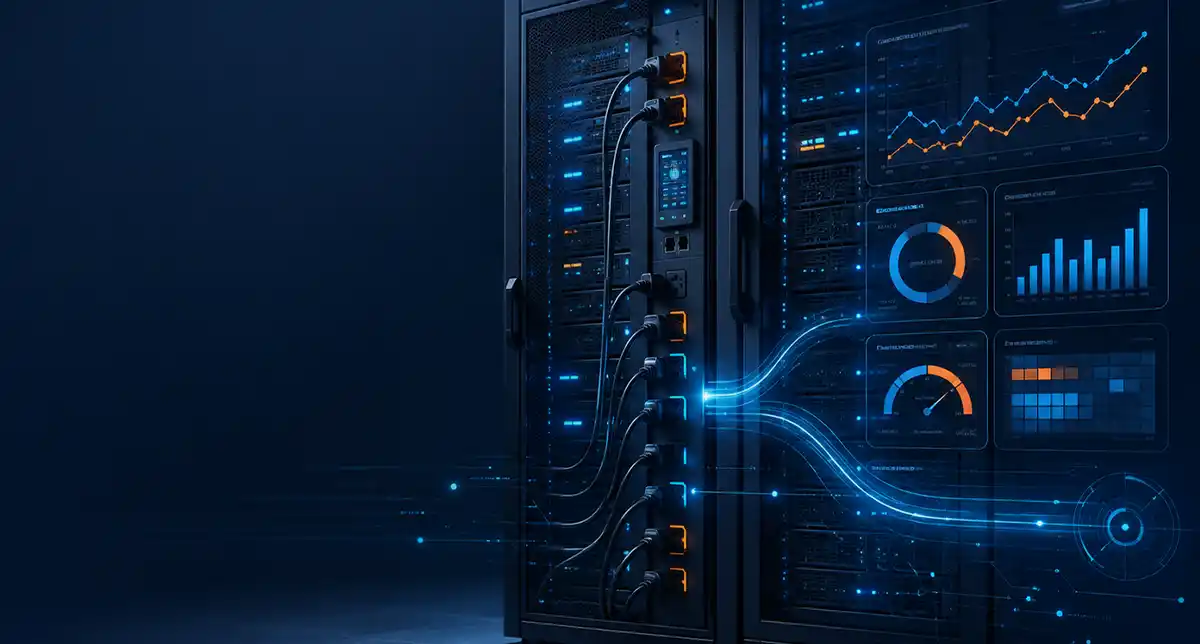
Power remains a critical resource in any data centre, yet today’s infrastructure demands more than a simple electricity meter reading.
Higher rack densities, AI workloads, high performance computing, and mounting pressure to boost energy efficiency have made power usage far more dynamic.
Consequently, effective data centre power management must go beyond mere metering.
Operators need to know exactly where power is consumed, how demand fluctuates over time, how much spare capacity remains, and whether current conditions signal an emerging problem.
Most importantly, they must translate that insight into concrete actions.
What Is Data Centre Power Management?
Data centre power management involves monitoring, analysing, and managing the electricity used across the facility. It can include data from infrastructure such as:
- Utility supplies
- Generators
- Uninterruptible Power Supplies (UPS)
- Main and sub distribution systems
- Intelligent PDUs
- Rack PDUs
- Individual PDU outlets
- IT equipment
Traditionally, teams watched each piece of infrastructure on its own: the UPS had its own dashboard, PDUs used separate software, and energy meters reported to a Building Management System (BMS). Each system delivered useful data, yet the information stayed isolated.
Furthermore, modern power management consolidates those measurements, consequently enabling operators to trace power flow through the facility and see how infrastructure reacts when demand shifts.
Power Metering Is Only the Starting Point
However, effective power management must answer several key questions:
- Where is power consumed?
- Which racks carry the highest load?
- How evenly do the electrical phases carry the load?
- How much spare capacity is left?
- Is demand increasing?
- When do peak loads occur?
- Is the installed capacity actually available where it is needed?
- How does power demand relate to temperature and cooling?
- Could current trends signal an emerging capacity or resilience problem?
However, simply gathering this information is not enough. Power monitoring gathers the measurements; power management uses those measurements to guide decisions. In other words, monitoring provides the data, while management turns that data into actionable insight.
Consequently, distinguishing between the two functions is essential for making informed, timely decisions about power usage and infrastructure resilience.
Different Levels of Power Visibility
The amount of operational insight available depends heavily on where power is measured.
Facility-Level Monitoring
By tracking incoming supplies and the major electrical distribution system, we gain a clear view of overall data centre demand.
This data lets organisations gauge total consumption, spot peak usage, and assess how well the infrastructure is being used.
However, these high level measurements often miss the details happening inside the facility’s deeper layers.
UPS and Distribution Monitoring
By continuously monitoring UPS systems and the electrical distribution network, operators gain real time insight into load levels, available capacity, and overall resilience.
This data enables them to see how each power path is performing and to spot when any part of the infrastructure is nearing its operational limits.
Furthermore, in facilities that rely on redundant A and B power supplies, such visibility becomes crucial—it allows teams to balance loads, anticipate potential failures, and maintain uninterrupted service.
Rack-Level Power Monitoring
Intelligent PDUs bring power visibility down to the rack level.
Instead of only measuring the total consumption of an entire data hall, operators can now monitor demand for each cabinet or rack.
As a result, this detailed information supports capacity planning and quickly highlights heavily loaded or underutilised areas. Moreover, it enables faster, data‑driven decisions about space and power allocation.
Per-Outlet Monitoring
Advanced intelligent monitoring PDUs measure power usage at each outlet, allowing operators to link consumption directly to specific servers or IT devices.
As a result, they gain far deeper insight into how individual assets draw from the available power capacity. However, this heightened detail also generates more data, and the challenge shifts to turning that information into actionable knowledge.
The Problem With More Data
Modern data centres generate huge amounts of operational information.
An intelligent PDU reports voltage, current, power, energy consumption, and other measurements. When you multiply those readings across dozens, hundreds, or even thousands of devices, the data volume grows rapidly.
However, simply having access to more measurements does not automatically improve data centre power management. If operators must log into multiple systems, compare spreadsheets, or manually investigate trends, useful information can easily get lost in the sheer volume of data.
Therefore, successful power management depends on context. Instead of looking at each reading in isolation, operators need to understand what those measurements mean across racks, rows, rooms, and the entire facility.
Turning Power Data Into Actionable Insight
When organisations centralise power information, they can begin using it to support practical operational decisions.
Identify Available Capacity
A rack can still have empty space for new equipment even when its power supply is nearly exhausted. If teams do not monitor power usage accurately, they might add hardware without realising they are creating a capacity or resilience risk.
Therefore, having real‑time and historical power data lets operators see exactly where genuine capacity exists before they deploy additional equipment.
Furthermore, this insight helps prevent over‑loading circuits and ensures that any expansion maintains system reliability.
Identify Stranded Capacity
Operators can face a different challenge: power capacity may be present in the data centre yet remain inaccessible where it is needed. For example, some racks can run close to their electrical limits while adjacent cabinets sit underutilised.
Moreover, detailed power data makes it easier to spot this stranded capacity.
Consequently, better‑informed infrastructure planning happens.
Improve Phase Balancing
Improving phase balancing starts with recognising that uneven electrical loads diminish the usable capacity of power systems.
Operators can continuously monitor each phase to spot any imbalances. When an imbalance appears, they can shift equipment to the less‑loaded phases.
As a result, organisations make more efficient use of their existing infrastructure while lowering the chance of overloading individual circuits or phases.
Consequently, the power network operates more reliably and closer to its full potential.
Understand Changing Demand
A single power reading shows operators what is happening right now.
Historical data reveals how demand is evolving over time.
By examining power trends, teams can spot gradual increases, recurring peaks, and shifts that occur after new equipment is installed.
Therefore, they can forecast future capacity needs using real measurements instead of relying on assumptions.
Power and Cooling Should Not Be Viewed Separately
Electrical demand and environmental conditions are closely linked.
When IT equipment draws more power, it generates more heat, so a higher rack density strains both the electrical capacity and the cooling system. Because of this interdependence, combining power data with environmental data offers operators valuable insight.
For example, suppose monitoring reveals a steady rise in power consumption for a particular rack. At the same time, temperature sensors show that inlet temperatures in that area are climbing. Viewed in isolation, each trend may seem harmless. Viewed together, however, they suggest the rack is nearing the limits of the local cooling infrastructure.
Integrating power‑monitoring tools with environmental monitoring solutions—such as iSensor—provides the additional context operators need. Instead of treating power and cooling as separate disciplines, operators can see how changes in one directly affect the other and act before problems arise.
From Threshold Alarms to Operational Awareness
Alarms remain essential to data centre power management.
They alert operators instantly when loads exceed set limits or when infrastructure changes state.
However, effective power management does more than simply react after a problem occurs; it also anticipates issues. By examining historical data, teams can spot gradual shifts before they become critical. For instance, a circuit that consistently runs at 50 % of its capacity might seem fine. If the record shows that this same circuit has risen from 30 % to 50 % over several months, the upward trend signals a growing risk.
Moreover, real‑time measurements tell us the current situation, while historical context reveals the underlying pattern and offers insight for proactive action.
Bringing Power Information Into Sensorium DCIM
As data centres grow more complex, operators must view power data together with the rest of their infrastructure.
Sensorium DCIM offers a vendor neutral platform that pulls power information from intelligent PDUs, UPS units, generators, and other electrical equipment into a single operational view.
Instead of juggling separate manufacturer portals, Sensorium consolidates data from diverse devices and systems.
Consequently, teams can see real time measurements, historical trends, and alarms from one central interface.
More importantly, Sensorium places power information alongside other critical infrastructure data, such as:
- Environmental conditions
- Cooling infrastructureRack and asset details
- Capacity metrics
- Building Management Systems (BMS)
- Rack access events
Sensorium Insight
Sensorium DCIM turns raw data into operational context.
A data centre manager can shift from asking, “How much power is this PDU using?” to questions like:
- Why has power consumption risen in this row?
- Do we have enough electrical and cooling capacity to add another high density rack?
- Are our A and B feeds still delivering the resilience we expect?
- Which racks offer sufficient genuine capacity for the next equipment deployment?
These questions transform monitoring data into actionable insight.
Vendor-Neutral Power Management Matters
Data centres typically host power equipment from multiple manufacturers.
Because infrastructure evolves over many years, UPSs, PDUs, meters, and building systems often come from different vendors and use distinct communication protocols. Instead of discarding perfectly functional equipment just to obtain a single monitoring platform, organisations can adopt a vendor‑neutral strategy.
This approach lets them integrate existing and new modern devices into one management environment, thereby modernising power management while protecting prior investments.
Moreover, it simplifies the gradual rollout of newer intelligent PDUs without creating isolated monitoring silos.
What Should Effective Data Centre Power Management Deliver?
An effective data centre power management strategy does more than compile meter readings. Operators should aim for:
- Real‑time visibility of current power conditions
- Historical trending that reveals changes over time
- Granular monitoring from the facility level down to individual racks or outlets when required
- Capacity information that supports future equipment deployment
- Intelligent alarms that flag abnormal operating conditions
- Vendor‑neutral integration across different equipment manufacturers
- Environmental context that links power demand with temperature and cooling
- Centralised reporting for operational and management teams
- Clear dashboards that turn large data sets into actionable information
Furthermore, the objective is not simply to collect more data; it is to enable better decisions.
In addition, by providing these capabilities, operators gain the insight needed to optimise energy use, prevent downtime, and plan capacity upgrades with confidence.
From Metering to Better Data Centre Decisions
Power metering provides the foundation for tracking a data centre’s energy use. Yet modern infrastructure demands far more than a single meter reading.
Operators must pinpoint where power is consumed, see how demand fluctuates, locate remaining capacity, and link electrical behaviour to cooling, resilience, and future growth.
Intelligent PDUs and similar monitoring devices supply the raw data needed for these insights. Platforms like Sensorium DCIM then aggregate that information, embed operational context, and help teams quickly spot issues that need attention.
This integrated approach defines the true goal of modern data centre power management.
Not simply measuring power — but turning power data into decisions.
Want Greater Visibility of Your Data Centre Power Infrastructure?
Advanced Datacentre Systems pulls power data from intelligent PDUs, UPS units, and other critical equipment into a unified Sensorium DCIM platform.
Moreover, if you are adding new intelligent PDUs or seeking greater value from your existing infrastructure, a vendor‑neutral approach turns scattered power measurements into clear, actionable insights. Consequently, you gain a unified view that drives smarter operational decisions.
Contact us today to discuss your requirements.
For our latest updates follow our company page on LinkedIn.