

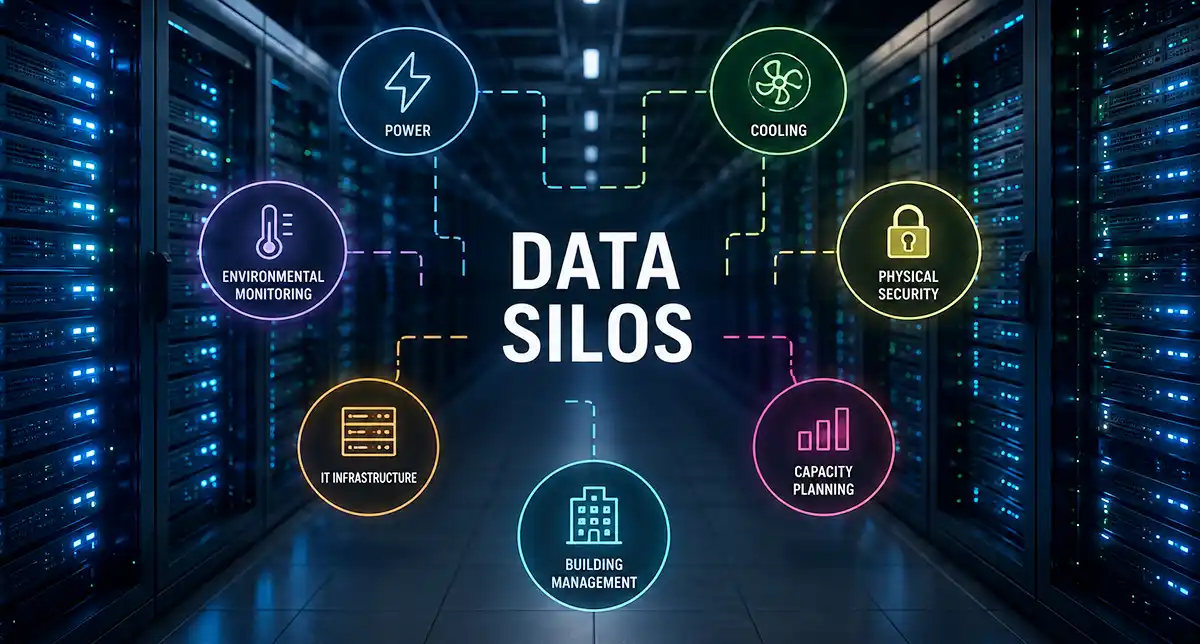
Modern data centres produce massive streams of operational data.
Power systems report loads and capacity. Environmental sensors track temperature and humidity. Cooling units log performance metrics. Access control systems record physical activity, while UPS devices, PDUs, Building Management Systems (BMS), and other infrastructure continuously broadcast their status.
However, the challenge is not a shortage of data; it is that much of this information stays isolated in separate systems. These data silos block operators from seeing how different components interact. As a result, a facility may have extensive monitoring yet fail to grasp the overall operational picture.
Therefore, for teams that prioritise uptime, energy efficiency, and resilience, dismantling these silos has become increasingly important.
What Are Data Silos?
When information stays isolated inside a single system, department, or platform, it becomes hard to reach or link with data elsewhere.
For example in a data centre
- One platform watches the UPS equipment.
- Another platform handles the cooling system.
- A separate BMS manages the building infrastructure.
- A different system controls physical access.
Each of these tools works well on its own. However, trouble appears when operators need to see how the tools relate to one another.
Why Connections Matter
Imagine a rack whose temperature starts to rise.
- The environmental monitoring tool flags the higher temperature.
- A PDU shows rising power consumption.
- The cooling system reports a change in airflow or cooling capacity.
If you look at each alert alone, they seem unrelated.
When you view them together, they reveal a clear pattern that could indicate an emerging problem.
Bottom Line
Linking information across systems is a key solution to eliminate data silos. It turns scattered alerts into actionable insight.
Why Do Data Silos Develop in Data Centres?
Organisations do not intentionally build data centres around isolated information.
Instead, data silos emerge slowly. Infrastructure expands, newer hardware replaces older equipment, and vendors supply dedicated monitoring platforms. Teams install specialised solutions to solve specific problems, while facilities, IT, and security groups each rely on applications tailored to their own needs.
As a result, operators end up juggling a growing assortment of monitoring tools.
Legacy equipment adds another layer of complexity; swapping out working hardware simply because it cannot talk to a newer management platform often seems unjustified. Consequently, many organisations keep old monitoring systems running alongside new technologies.
The outcome is a data centre rich in data yet lacking a simple way to bring that information together.
1. Data Silos Can Slow Incident Response
When something goes wrong, operators need context to understand the problem.
An alarm tells you what has occurred, but data from the surrounding infrastructure often reveals why it occurred. If engineers must open several applications, compare timestamps, and manually cross reference information, troubleshooting becomes more complicated—especially when multiple events happen close together.
For example, when an engineer investigates a rack temperature alarm, they typically need to check:
- Rack power consumption
- PDU loading
- Cooling performance
- Environmental conditions elsewhere in the row
- Door or rack access activity
- Recent alarms and historical trends
When these datasets live in separate systems, the engineer must assemble the picture manually. An integrated platform simplifies this task by bringing the related data together, making the relationships easy to see and act on.
2. Different Systems Can Create Different Versions of the Truth
Data silos create operational confusion.
Facilities teams often rely on the Building Management System (BMS), while IT teams use a network management platform, and security teams may work with a completely different system.
Consequently, each team sees only the data that pertains to its own responsibilities, and no one views the whole operational picture. As a result, teams can draw different conclusions because they base their decisions on distinct information.
Our article on Data Centre Visibility Issues examines this problem, highlighting fragmented monitoring as a major barrier to full infrastructure visibility.
Breaking down data silos does not require every team to share an identical dashboard; instead, it means they should all draw from the same underlying data.
3. Data Silos Can Hide Relationships Between Power and Cooling
Power and cooling work together in a data centre.
When the IT load changes, the heat it produces changes as well, so the cooling system must adjust to the actual conditions inside the racks. If operators keep power data separate from temperature, humidity and cooling measurements, they miss important context— a temperature reading alone shows only part of the picture.
By looking at temperature, humidity, rack power and cooling information side by side, teams gain a far clearer view of how the infrastructure is performing.
This approach is especially useful when they want to improve cooling efficiency or troubleshoot hot spots in high density areas. The goal isn’t just to gather more data; it’s to understand the relationships hidden in the data they already collect.
4. Fragmented Monitoring Can Make Alarm Fatigue Worse
Adding more monitoring systems often creates more sources of alarms.
One platform may report a temperature warning while another sends a cooling notice. A UPS can trigger its own alert, and a PDU may issue a separate notification. When these alerts arrive without context, operators see a flood of individual messages and struggle to determine which event needs immediate attention.
This overload can lead to alarm fatigue in data centres, especially when each platform treats its alarms in isolation.
By centralising the information, we give alarms the context they need. Instead of forcing operators to piece together disconnected events, an integrated management platform lets them see the full picture of the infrastructure and prioritise their response accordingly. Consequently, operators can act faster and more confidently.
5. Physical Security Can Become Another Data Silo
Physical security data is often kept separate from other infrastructure information.
However, activity inside a data hall adds valuable operational context.
For example, if an unexpected change appears on a rack shortly after maintenance, knowing who opened the cabinet just before the event can help investigators pinpoint the cause. Without integration, engineers must ask another team for access logs before they see the connection.
Rack level access control becomes far more useful when operators can view entry events alongside other operational data. Our iAccess Controller does exactly that: it links with management platforms such as DCIM, BMS, and NMS through SNMP, feeding rack access records and audit data into a broader monitoring environment.
As a result, physical access transforms from an isolated security log into an actionable layer of operational intelligence.
6. Data Silos Can Make Infrastructure Harder to Manage as It Evolves
Data centres constantly evolve.
Equipment changes, manufacturers shift, and technologies advance, so infrastructure is upgraded piece by piece rather than all at once.
Consequently, proprietary monitoring platforms grow increasingly restrictive.
When a new piece of hardware from a different vendor is added, it often demands its own management interface. Over time, organisations end up juggling several monitoring systems simply because the various components cannot talk to one another.
Swapping out still functional equipment just to gain monitoring compatibility rarely makes sense.
A vendor neutral approach offers a practical alternative.
Instead of forcing every device to fit a single hardware ecosystem, the management layer can pull data from disparate manufacturers and technologies into one unified view. This capability proves especially valuable in environments that blend modern and legacy equipment.
Breaking Down Data Silos Does Not Mean Replacing Everything
One key insight about data silos is that fixing them doesn’t mean you must discard the systems that created them.
Your BMS can still carry out vital tasks. Likewise, your environmental monitoring system can deliver the precise data you need. Moreover, your Power Distribution Units, Uninterruptible Power Supplies, and cooling infrastructure often have many productive years left.
Consequently, we should prioritise integration over replacement.
By adopting a management strategy that builds a shared layer, you can gather data from diverse sources and present it in a clear, operator friendly format. This method lets you preserve existing investments while steadily moving toward a more connected infrastructure.
How Vendor-Neutral DCIM Helps Break Down Data Silos
Data Centre Infrastructure Management (DCIM) can play a key role here.
A vendor neutral DCIM platform works as a bridge that links formerly isolated infrastructure systems. Instead of adding another siloed monitoring tool, it gathers data from many sources into one view. Sensorium DCIM follows this principle.
It pulls information from PDUs, environmental sensors, access control systems, building services, and other devices, and its adaptable communication layer connects to both new and legacy equipment. After collecting the data, Sensorium displays it on central dashboards, floor plan maps, trend charts, and alarm panels.
As a result, operators see a clear, system wide picture of how the infrastructure performs.
Bringing Environmental Monitoring Into the Same Picture
Environmental monitoring offers a clear illustration of this principle.
Temperature and humidity readings are valuable on their own, but their usefulness grows when teams compare them to rack power, cooling performance, and other infrastructure data.
The iSensor Controller collects environmental data from up to 24 rack- or room-mounted sensors, then uses SNMP to feed that information directly into your broader management systems.
By feeding this information into Sensorium, environmental conditions stop being an isolated dataset.
Instead, operators can view them alongside the infrastructure factors that may be causing changes—allowing faster, more informed decisions.
Creating One Operational View
Breaking down data silos does not flood operators with every data point.
Instead, it gives them clear, integrated views.
Each team keeps its own dashboard—facilities engineers watch power and cooling, IT managers track rack capacity and infrastructure performance, and security staff focus on rack access.
Although each dashboard looks different, all of them pull data from a single, connected environment. This shared view creates a common operational picture while letting each team concentrate on what matters most.
For example, the Unifying IT and Building Management Systems case study shows the benefit: Sensorium linked IT infrastructure and building systems without forcing the organisation to replace existing equipment.
From Isolated Data to Operational Intelligence
Data by itself has no value—its worth emerges from what operators can learn from it.
When power, cooling, environmental, security, and infrastructure data stay locked in separate platforms, teams often miss the connections that reveal risks, improve performance, and speed up problem solving.
Breaking down those data silos changes the game.
It turns isolated readings into a unified context.
Now operators can shift from asking “What is this system telling me?” to asking “What is happening across my entire data centre?”
That shift makes a significant difference.
Conclusion: Data Centres Need Connected Information
As data centre infrastructure grows more complex, simply adding another standalone monitoring tool won’t fix the visibility problem.
Operators already have data; they just need to connect it.
By breaking down data silos that separate power, cooling, environmental, security, and building information, teams can correlate events across all systems. This gives them a clearer operational picture and supports better informed decisions.
A vendor neutral DCIM platform offers a practical way to achieve this without forcing organisations to replace equipment that works just because it comes from different manufacturers or generations.
Our Sensorium DCIM brings previously disconnected infrastructure into a single operational management environment.
In short, the challenge isn’t gathering more data—it’s making the data you already have work together.
For latest updates follow our company page on LinkedIn.
Frequently Asked Questions About Data Silos
What are data silos in a data centre?
When isolated departments or incompatible systems trap operational information, data silos emerge. Consequently, teams struggle to share and analyse insights, ultimately making it much harder to gain a clear, unified view of the entire data centre.
Why are data silos a risk?
Data silos delay incident responses and blur your overall visibility, making it nearly impossible to connect the dots between power, cooling, environmental conditions, and physical security. Furthermore, these isolated systems force different teams to operate from conflicting versions of the same reality.
How can DCIM help reduce data silos?
By centralising data from multiple infrastructure systems into a single vendor-neutral DCIM platform, operators can seamlessly correlate alarms, trends, and metrics instead of juggling separate tools.
Do you need to replace legacy equipment to eliminate data silos?
Not necessarily. Platforms like Sensorium DCIM connect modern and legacy infrastructure seamlessly, allowing organisations to boost visibility while keeping their current equipment in place.