

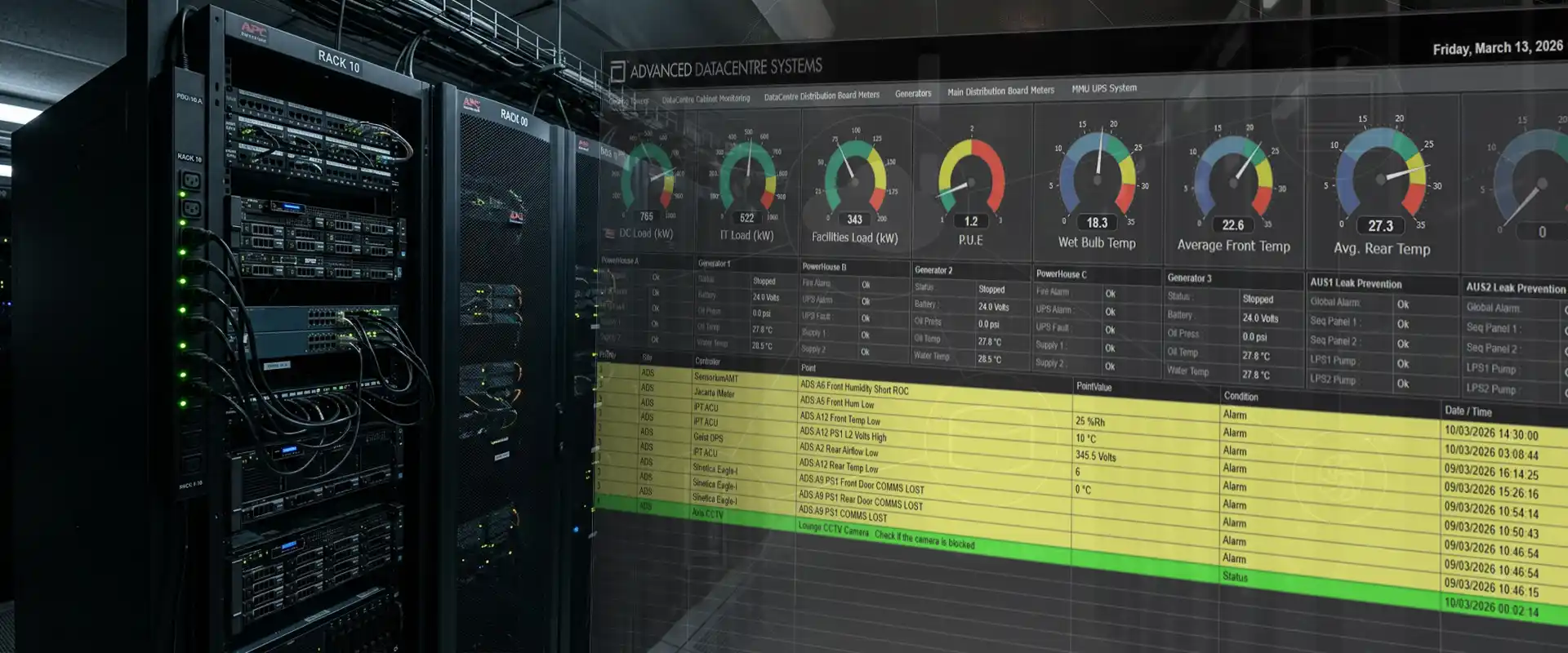
Power Usage Effectiveness (PUE) has become the industry-standard metric for measuring data centre energy efficiency. As data centres grow in scale and complexity, operators face increasing pressure to reduce energy costs while meeting sustainability and performance targets. However, without the right visibility and tools, PUE can be difficult to track accurately or improve. Understanding how PUE works is the first step towards turning energy data into meaningful, actionable insight.
What is Power Usage Effectiveness (PUE)?
Power Usage Effectiveness (PUE) stands as the data centre industry’s primary benchmark for measuring energy efficiency. In simple terms, this metric reveals how much total energy a facility consumes versus how much of that energy actually powers IT equipment.
Calculating PUE: PUE = Total Facility Energy ÷ IT Equipment Energy
A PUE of 1.0 represents perfect efficiency—every watt your facility draws directly supports IT equipment with zero waste. Most data centres, however, operate with PUE values between 1.2 and 2.0. These numbers fluctuate based on a facility’s design, the age of its infrastructure, and its operational practices.
Why PUE Matters for Data Centre Efficiency
PUE has become a critical benchmark for organisations aiming to reduce operational costs and meet sustainability targets.
PUE (Power Usage Effectiveness) has emerged as an essential performance indicator for organisations that want to lower their operational expenses and demonstrate genuine progress toward sustainability objectives. A PUE value closer to 1.0 indicates that most energy reaches the computing hardware, while higher values reveal significant losses in cooling, power distribution, and supporting systems.
1. Reduces Energy Costs
Energy consistently ranks among the biggest operational costs for any data centre. When a facility achieves a lower PUE score, it directly translates into reduced waste across cooling systems, power distribution units, and auxiliary infrastructure. These savings compound over time, freeing capital for strategic investments rather than covering unnecessary utility bills.
2. Supports ESG and Sustainability Goals
Every improvement in PUE directly cuts carbon emissions associated with data centre operations. As regulations tighten and stakeholders demand greater environmental accountability, efficient data centres have become central to robust Environmental, Social, and Governance (ESG) strategies. Organisations that demonstrate measurable efficiency gains position themselves as responsible corporate businesses committed to reducing their environmental footprint.
3. Improves Operational Visibility
Monitoring PUE forces operators to confront inefficiencies that might otherwise remain hidden. The metric acts as an early warning system, revealing problems such as suboptimal cooling distribution, inadequate airflow management, or aging infrastructure that consumes power without delivering corresponding computing capacity. This visibility empowers teams to target improvements where they matter most.
4. Enhances Competitive Advantage
Colocation providers and enterprise data centres increasingly leverage PUE as a benchmarking tool to demonstrate their operational excellence to potential customers and investors. A consistently low PUE signalises technical competence and cost efficiency, giving these organisations a meaningful edge when competing for business in an increasingly sustainability-conscious market.
What Impacts PUE?
Understanding what drives Power Usage Effectiveness helps data centre managers make smarter decisions about efficiency investments. A handful of key factors determine whether a facility runs efficiently or wastes significant energy, and recognising these variables gives operators the knowledge they need to improve performance.
Several interrelated factors shape PUE performance in any data centre environment:
- Cooling system efficiency– Poorly designed cooling setups or inadequate airflow management force cooling systems to work overtime, consuming far more electricity than necessary to maintain safe operating temperatures.
- Power distribution losses– Every UPS system, transformer, and power distribution unit along the electrical chain introduces some level of inefficiency, and these losses accumulate across the entire infrastructure.
- IT load levels– Data centres running servers at low utilisation rates typically show inflated PUE readings because the facility infrastructure supports a relatively small computing workload, meaning the overhead energy represents a larger portion of total consumption.
- Environmental conditions– External climate patterns and the internal temperature setpoints chosen for equipment both affect how hard cooling systems must work, with hotter climates and cooler setpoints typically demanding greater energy inputs.
- Legacy infrastructure– Older servers, networking equipment, and building systems generally operate with far lower energy efficiency than modern alternatives, creating drag on overall facility performance.
Without accurate, real-time visibility into these areas, data centre teams cannot pinpoint exactly where energy waste occurs or prioritise improvements effectively.
The Challenge: Measuring PUE Accurately
The PUE formula—total facility power divided by IT equipment power—looks straightforward on paper. However, data centres consistently find that achieving reliable, actionable PUE measurements requires far more effort than the mathematics suggest.
Data centres encounter several recurring problems when they attempt to measure and track PUE effectively.
- Fragmented data collection creates the first major hurdle. Information flows from separate systems—building management platforms, DCIM tools, smart PDUs, and utility meters—that do not communicate with one another. This fragmentation forces teams to manually consolidate data from multiple sources, which introduces errors and delays.
- Infrequent or manual sampling undermines measurement reliability. When teams only check readings quarterly or rely on handwritten logs, they miss the power fluctuations that occur hourly or even minute-by-minute. These gaps prevent them from identifying inefficiencies that spike and settle within short timeframes.
- Insufficient granularity at the rack or zone level limits actionable insights. Whole-facility PUE numbers tell managers that something is inefficient, but they cannot pinpoint whether a specific server row, cooling zone, or tenant cage drives the problem. Without this detail, optimisation efforts become guesswork.
- Difficult historical analysis compounds these challenges. When data lives in disconnected spreadsheets or incompatible formats, tracking trends across months or years becomes time-consuming. Teams cannot easily compare seasonal patterns, measure the impact of hardware changes, or model future scenarios.
When these problems persist, reporting suffers from inaccuracies that obscure true performance. More importantly, organisations miss optimisation opportunities because they cannot identify where waste occurs, when it happens, or why. Reliable PUE measurement demands integrated, real-time, granular data that most data centres currently struggle to achieve.
How DCIM Improves Power Usage Effectiveness
Data Centre Infrastructure Management (DCIM) platforms transform how facilities track and optimise energy performance. By delivering real-time visibility into power consumption across IT equipment and supporting infrastructure, these tools turn PUE from a static metric into a dynamic optimisation lever.
1. Real-Time Energy Monitoring
Continuous monitoring captures power usage across every layer of the facility. This constant data stream enables accurate, moment-by-moment PUE calculations, replacing periodic manual audits with reliable live metrics.
2. Granular Breakdown
Traditional approaches yield only facility-wide PUE figures. DCIM reveals efficiency at progressively finer levels:
- Room-level analysis.
- Row-level performance.
- Rack-level granularity.
This layered view isolates problem areas with surgical precision, guiding resources where they matter most.
3. Historical Analytics and Trending
Time-series data unlocks insights that point-in-time measurements miss. Teams can:
- Trace seasonal consumption shifts.
- Quantify the impact of physical or procedural changes.
- Build accurate forecasts for future energy demands.
4. Proactive Alerting
Intelligent threshold settings trigger immediate notifications when efficiency drops below acceptable levels. This early warning system lets operators address problems before unnecessary energy waste compounds.
5. Integration with Environmental Monitoring
Power data gains meaning when combined with temperature, humidity, and airflow readings provided by environmental monitoring systems such as the iSensor Controller. DCIM platforms that correlate these factors paint a complete picture of what drives—or undermines—efficiency, enabling decisions rooted in comprehensive insight rather than isolated metrics.
Optimising PUE with DCIM in Practice
Improving Power Usage Effectiveness is not a one-time task—it demands ongoing effort and adjustment.
With a powerful DCIM platform, data centre teams can:
- Detect cooling inefficiencies and pinpoint hotspots fast.
- Reduce overcooling and eliminate wasted energy.
- Match workloads to servers for better efficiency.
- Plan capacity with greater accuracy and confidence.
- Confirm the actual impact of infrastructure upgrades
How Sensorium DCIM Supports PUE Optimisation
Managing Power Usage Effectiveness effectively requires more than occasional spot-checks—it demands continuous, actionable insight into every watt flowing through your infrastructure. Sensorium DCIM from Advanced Datacentre Systems delivers exactly that by consolidating all your critical data into a single, intuitive dashboard.
With Sensorium, your team gains:
- Real-time PUE visibility— calculate and monitor your efficiency metrics as they happen, not hours or days later.
- Seamless integration— connect both legacy systems and modern equipment without disruption or costly replacements.
- Custom energy dashboards— surface the insights that matter most to your operations and stakeholders.
- Historical trend analysis— track performance over time and identify patterns that drive meaningful improvements.
- Complete vendor independence— avoid lock-in and maintain flexibility across your multi-vendor environment
Instead of piecing together fragmented tools and wrestling with manual spreadsheets, Sensorium gives you the clarity to transform PUE from an abstract benchmark into a practical lever for reducing costs, improving sustainability, and optimising daily operations.
Best Practices to Improve PUE
Improving Power Usage Effectiveness requires a strategic approach to managing your data centre’s power and cooling infrastructure. By implementing these proven methods, you can significantly reduce energy waste and lower operational costs while maintaining optimal equipment performance.
Key Strategies for Maximum Efficiency:
- Implement hot aisle / cold aisle containment systems to prevent air mixing.
- Raise temperature setpoints within ASHRAE-recommended ranges when equipment allows.
- Deploy free cooling techniques during cooler weather conditions.
- Audit and refine airflow management practices to eliminate bypass and recirculation.
- Analyse power and cooling performance metrics on a consistent schedule.
- Utilise DCIM platforms to enable real-time monitoring and continuous optimisation.
These practices work together in harmony—containment improves the effectiveness of temperature adjustments, while robust monitoring ensures you catch inefficiencies before they escalate. Start with an assessment of your current PUE baseline, then prioritise improvements based on your facility’s specific weaknesses and climate conditions.
Conclusion: Turning PUE into Strategic Insight
Power Usage Effectiveness stands as one of the most critical metrics in data centre operations—but its value hinges entirely on how organisations measure and apply it.
When data lacks accuracy and visibility, PUE becomes nothing more than a hollow number on a report. Organisations that invest in the right Data Centre Infrastructure Management (DCIM) platform unlock PUE’s true potential, converting it into a powerful strategic asset. This transformation drives meaningful cost reductions, sharpens operational efficiency, and strengthens progress toward sustainability objectives.
The message is clear: raw data alone does not create value. Only when teams can access reliable metrics, analyse trends, and act on insights does PUE become a catalyst for smarter decision-making and measurable improvement across the facility.
If you want to gain real-time visibility into your energy performance and take control of your PUE, explore how Sensorium DCIM can help transform your data centre operations.