

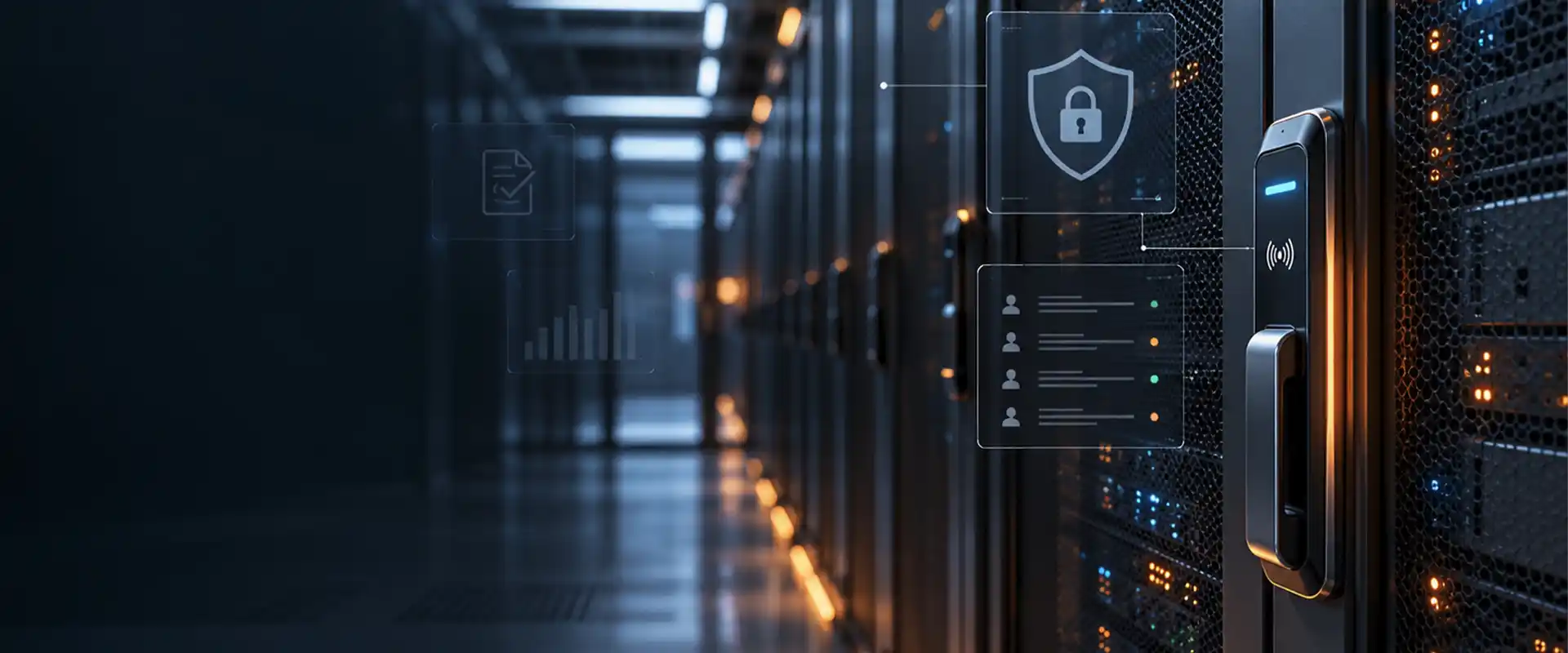
Data centre compliance requires more than policies, procedures, and documentation; organisations must also show that they control, monitor, and record access to critical infrastructure.
As a result, physical security therefore becomes a key part of the compliance process.
Most data centres already secure the perimeter with security passes, biometric readers, CCTV, and staffed entrances, which stop unauthorised individuals from entering the facility. However, entering the data hall does not automatically grant permission to touch every rack inside it.
Subsequently, this raises an important question: can you prove exactly who accessed specific IT equipment and when?
Rack-level access control solves this issue. Because by managing and logging entry at the cabinet level, organisations boost accountability and can produce solid evidence for audits and compliance reviews.
Why physical access matters for data centre compliance
Modern data centres house infrastructure that supports critical business systems, customer information, and sensitive data. Consequently, organisations must implement appropriate physical security controls.
However, compliance rarely follows from merely installing a lock.
Because of this, organisations must understand who may access equipment, how they control that access, and whether they keep a reliable record afterward.
Subsequently, this issue becomes especially critical in facilities where many different people may legitimately enter the data hall, such as employees, contractors, engineers, customers, and third party service providers, who may need access at different times.
Facility-level access control records who entered the room, but it does not necessarily indicate which rack they accessed. Moreover, that distinction can become significant during an audit or investigation.
The gap between data hall security and rack security
Imagine a colocation facility with hundreds of cabinets. A customer, contractor, or engineer may have legitimate permission to enter the data hall, but that does not mean they should automatically gain access to every cabinet.
Traditional mechanical locks make this difficult to manage, because keys can be copied, lost, or shared. Furthermore, because many rack manufacturers use standard keyed‑alike locks, the risk increases even more. Also, from a compliance standpoint, a conventional lock leaves almost no evidence of what happened when a cabinet is opened.
When a cabinet opens, there may be no automatic record showing:
- who opened it;
- when they opened it;
- how long it remained open;
- whether the access was authorised;
- or whether an unexpected access event occurred.
Electronic rack access control solves these problems by providing a much stronger audit trail.
Creating an audit trail at rack level
Electronic access control lets us link each access event to a specific credential.
Instead of using a physical key, authorised staff present an electronic credential to open a cabinet. As a result, the system logs the action automatically. This log builds a detailed history of rack openings.
For data centre operators, that history supplies concrete evidence during audits, incident investigations, or reviews of security procedures. Instead of merely stating that it restricts access, the organisation can demonstrate that it does.
For example, the records answer questions like: Who opened the rack? When did it happen? Was the person authorised? Were any openings unusual?
Consequently, rack security shifts from a passive barrier to an active, measurable process.
Supporting accountability and least-privilege access
Effective access control directly supports the principle of least privilege: staff should only be able to reach the systems and areas necessary for their specific duties.
Consequently, applying this principle at the rack level adds an extra layer of physical protection. For example, an engineer who maintains one group of cabinets does not need to enter racks that belong to another department or customer.
Electronic access control systems make it possible to set and adjust permissions with far greater precision than traditional keys can provide. When an employee’s responsibilities change, their access rights can be updated instantly, allowing organisations to rely less on managing physical keys while keeping tighter control over who can open each cabinet.
Furthermore, this approach is especially valuable in colocation facilities, shared data halls, and any setting that frequently brings in external contractors.
Helping support compliance frameworks
Rack access control alone does not guarantee data centre compliance. Compliance instead relies on a mix of technical controls, policies, procedures, risk management, and documented evidence.
Furthermore, physical access controls can help satisfy many requirements found in common security and governance frameworks.
For example, ISO/IEC 27001 lists physical security among its information security controls. Similarly, organisations pursuing other regulatory or industry standards often need to show that they restrict access to systems and infrastructure appropriately.
Consequently, the key factor is not the technology itself but the organisation’s ability to prove that its controls exist and operate effectively.
As a result, detailed access records become valuable evidence that auditors and regulators can review.
Making audits easier
Preparing for an audit becomes time consuming when evidence spreads across multiple systems or relies on manually kept records.
As a result, automated rack access logging simplifies this process.
Instead of searching key registers or depending on staff memory, operators can consult the recorded access events. This makes it easier to show how access is controlled and to investigate exceptions. Also, it supports internal reviews between formal audits.
For example, operators can spot repeated access to a specific cabinet, detect unexpected entries outside normal working hours, or notice attempts to use equipment without proper permission.
Consequently, the benefits go beyond compliance; the same data improve day to day operational awareness.
Combining access control with wider data centre monitoring
Rack access data becomes more valuable when it sits inside a broader monitoring environment.
ADS iAccess Controller delivers electronic, rack-level access control that integrates directly with Sensorium™ DCIM. As a result, physical access events feed into the overall operational picture instead of staying isolated in a standalone security system.
Furthermore, when an operator investigates an incident, they often need to know what else was occurring at that moment. Access logs supply that context, joining environmental readings, alarms, and infrastructure monitors.
Consequently, data centre security shifts from the simple query “Was the door locked?” to a richer inquiry: “Who accessed the rack, when did they do so, and what else was happening in the facility at that time?”
From physical security to demonstrable control
Compliance now hinges on solid evidence.
A locked cabinet creates a basic physical barrier, but adding electronic rack access control brings identity, accountability, and an audit trail to that barrier.
Therefore, for data centre operators, the combination bridges the gap between overall facility security and the specific equipment that needs protection.
More importantly, it shows that physical access controls are not just written policies; they are active, measurable measures that reviewers can examine and audit.
Consequently, as data centre environments grow more complex and security demands evolve, this visibility becomes increasingly vital.
Controlling access is important. But being able to prove that access was properly controlled is equally as important.
For our latest updates follow our company page on LinkedIn.