

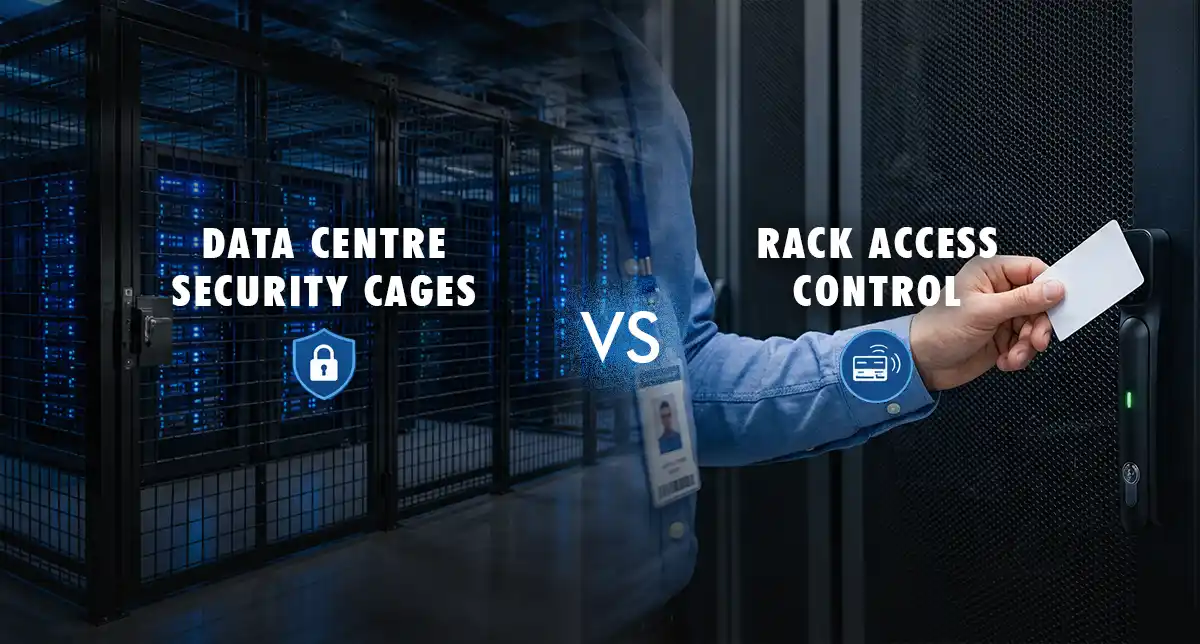
Data centre security cages are increasingly used within colocation facilities to give customers private, physically isolated sections within a shared data hall. These enclosures safeguard equipment, streamline regulatory compliance and reassure organisations that neighbouring tenants cannot reach their infrastructure.
Furthermore, cages represent just one layer of physical security. Once someone gains entry to a cage, conventional measures often fall short—there’s limited control over which racks they can access, how long they stay or whether they had permission to open a particular cabinet.
Rack access control fills this gap. Instead of replacing cages, it adds intelligent protection at the cabinet level, granting granular permissions, maintaining detailed audit logs and triggering instant alerts when something seems off.
This guide examines the differences between security cages and rack access control, highlights the strengths of each and explains why many operators now deploy both to maximise physical security.
What Are Data Centre Security Cages?
Data centre security cages are lockable mesh enclosures that create physically isolated zones within a shared data hall for each customer. They are especially common in colocation data centres, where many organisations share the same building but must guarantee that only authorised staff can reach their equipment.
Typical security cage features include:
- Lockable mesh walls and doors
- Dedicated customer zones
- Controlled entry points
- Physical separation from neighbouring tenants
Unlike private suites, security cages allow operators use floor space efficiently while still providing customers a clearly defined, secure environment.
Why Colocation Providers Use Security Cages
Security cages remain a top choice for data centres—and for good reason. Because they effectively address key operational and security challenges.
Customer Separation
Firstly, physical segregation stands out as the primary benefit. Each customer occupies their own enclosed space, which prevents accidental or unauthorised access between tenants.
This setup proves especially valuable in multi-tenant facilities where hundreds or even thousands of racks coexist within a single data hall.
Supporting Compliance
Secondly, many organisations need documented proof that their IT infrastructure remains physically separate from other tenants. Data centre security cages provide this evidence during audits and help demonstrate compliance with standards such as ISO 27001, PCI DSS, and other industry regulations.
Efficient Use of Data Centre Space
Thirdly, constructing individual data halls for each customer would cost far too much. Security cages enable providers to house multiple customers securely while sharing critical infrastructure like cooling and power.
A Visible Security Deterrent
Finally, A lockable enclosure adds a physical barrier that discourages unauthorised access and strengthens the facility’s overall security posture.
Where Data Centre Security Cages Have Limitations
While data centre security cages effectively guard the perimeter, they offer limited control once someone is inside the protected area.
This difference matters. While the cage secures the overall space, it doesn’t protect individual racks. Consequently, once inside the cage, authorised personnel can typically reach every cabinet within it.
This group may include:
- Customer engineers
- Remote hands teams
- Third-party maintenance contractors
- Hardware vendors
- Temporary support staff
All these individuals may have valid reasons to enter the cage, yet they rarely need access to every rack. Therefore, without supplementary controls, operators cannot limit access to specific cabinets.
Limited Audit Trails
Standard rack handles and keyed locks seldom record who accessed a rack or when. If a server goes offline, operators struggle to answer these questions:
- Who opened the rack?
- When did the access occur?
- How long did the door stay open?
- Was the access authorised?
Intelligent rack security solves this problem.
Shared Keys and Manual Processes
Many facilities still depend on mechanical keys or hand-written access logs. Over time, people copy keys, share them, or misplace them. Paper records and spreadsheets easily introduce human error into your data.
Furthermore, they fail to meet the strict accountability standards that modern compliance requirements demand.
What Rack Access Control Adds
While a security cage limits entry to an area, rack access control secures each cabinet individually. Every rack becomes its own controlled security zone, giving operators the ability to grant, monitor, and record access with far greater precision.
Consequently, solutions such as iAccess provide electronic locking and intelligent management that dramatically improve visibility and accountability.
Individual Rack Permissions
Instead of giving an engineer a key that opens every cabinet in a cage, administrators can assign permission only to the specific rack the person needs to service. As a result, this limits exposure and ensures staff can access only the equipment they’re authorised to maintain.
Complete Audit Trails
The system automatically logs each access, capturing:
- User identity
- Date and time
- Rack accessed
- Door opened/closed status
- Unsuccessful access attempts
These logs supply valuable evidence for security investigations, customer reporting, and regulatory compliance.
Temporary Access Rights
Contractors and remote hands engineers often need access for a short period. Rather than issuing permanent keys, electronic permissions can be granted for a particular rack only during a defined maintenance window and then automatically expire.
Real Time Alerts
If a rack door is forced open, left ajar, or accessed outside approved hours, authorised personnel receive instant notifications. When integrated with a DCIM platform such as Sensorium, these alerts appear alongside environmental monitoring, power management, and infrastructure alarms, delivering a holistic operational view.
Security Cages vs Rack Access Control
Although both solutions improve physical security, they address different requirements.
| Feature | Security Cages | Rack Access Control |
|---|---|---|
| Customer separation | ✅ | ✅ |
| Individual rack permissions | ❌ | ✅ |
| Electronic audit trail | Limited | ✅ |
| Temporary access rights | ❌ | ✅ |
| Remote unlocking | ❌ | ✅ |
| Real-time security alerts | Limited | ✅ |
| Rack-level accountability | ❌ | ✅ |
| DCIM integration | Limited | ✅ |
Rather than competing technologies, they should be viewed as complementary layers within a wider physical security strategy.
Can Rack Access Control Replace Security Cages?
Undeniably, the right solution depends on your deployment size, security requirements, and how you operate the data centre.
For large colocation facilities, security cages usually make the most sense.
Security cages create dedicated spaces for customers with multiple racks or entire cabinet rows, providing clear physical separation between tenants. Because of this they remain a cornerstone of physical security in these environments.
That said, you don’t always need a cage.
For instance, when a customer occupies just one or two racks, building a cage around them wastes floor space and adds installation and maintenance costs. In these cases, rack access control offers a smarter alternative.
This approach secures each cabinet individually. Operators can assign specific racks to authorised users, manage access permissions remotely, and automatically log every entry. As a result customers still get the security they expect without the overhead of a dedicated enclosure.
For colocation providers, this flexibility pays off. You can grow or shrink customer footprints without reconfiguring cage layouts, and onboarding new customers happens much faster.
Think of these two solutions as partners, not rivals.
Security cages protect the customer space itself, while rack access control safeguards the individual assets inside. The most robust physical security strategy uses both.
Which Solution Offers Better Value?
The answer largely depends on the deployment.
For customers occupying dozens of cabinets, security cages remain a solid choice. They create clear physical separation and establish dedicated customer environments.
However, full cages aren’t always practical. When a customer only rents one or two racks—or just a single compartment—a cage wastes valuable floor space. It also requires heavy installation work and ongoing maintenance.
Subsequently, in these cases, rack access control delivers tighter security without the hassle of building and maintaining a cage. It also gives operators features that traditional cages simply can’t match. You get detailed audit trails, electronic access management, and seamless integration with your DCIM systems.
The Best Practice: Layered Physical Security
Top tier colocation providers treat security cages and rack level access control as complementary tools, not rivals. They weave both into a defence in depth strategy that stacks multiple protective layers.
As a result a typical security stack includes:
- Secure the site perimeter
- Control building entry
- Manage reception and visitor check in
- Require biometric authentication to enter the data hall
- Grant access through security cages
- Enforce individual rack level access control
- Run continuous monitoring and audit logging
Consequently, each layer lowers risk and strengthens accountability. As a result, if an attacker evades one control, the remaining layers still shield the customer’s infrastructure.
Conclusion
While data centre security cages keep shared colocation spaces separate, they have a blind spot: they can’t track who accesses individual cabinets or when.
Therefore, integrating intelligent rack access control fixes this. It drives security deeper, giving you:
- Full accountability with detailed audit trails.
- Strict compliance and total operational control.
- Peace of mind from the perimeter to the individual rack.
As a result don’t choose between cages and rack access control. Combine them to build a stronger, layered data centre security strategy.
Frequently Asked Questions (FAQs)
What is a data centre security cage?
A data centre security cage is a lockable mesh enclosure that creates a private, physically separate space within a shared data hall. Colocation facilities commonly install these cages to give tenants dedicated, secure areas for their IT equipment while sharing the building with other organisations.
These enclosures restrict access to authorised personnel, adding a critical layer of physical security. Meanwhile, tenants still benefit from shared power, cooling, and network infrastructure.
Are security cages enough to secure server racks?
Security cages effectively restrict entry to a customer’s allocated area, but they seldom limit access to the individual server racks inside.
As a result once someone gains authorised entry to the cage, they can still open any cabinet unless the data centre adds supplemental rack‑level safeguards.
Organisations that need precise accountability and comprehensive audit logs frequently pair cages with smart rack‑access control systems.
What is rack access control?
Rack access control is an electronic security solution that restricts entry to each server cabinet, rather than securing the entire room. Authorised users unlock the cabinets with credentials such as RFID cards, or biometric scans—the exact method depends on the system in place.
Solutions like iAccess also log every access event, generating a complete audit trail that records who opened each rack, the exact time of entry, and how long the cabinet stayed open.
Can rack access control replace security cages?
Rack access control can, in some cases, replace security cages.
When a customer only occupies one or two server racks, installing individual rack‑level access control eliminates the need to build a dedicated cage, saving both cost and floor space.
For larger deployments that span multiple cabinets or entire rows, however, security cages remain the preferred way to create a physically isolated area.
Consequently, many colocation providers combine cages with rack‑level access control, using both in a layered physical‑security strategy.
What are the advantages of rack access control over traditional keys?
Basically mechanical keys offer only simple protection with no visibility or control over who accesses your equipment.
Electronic rack access control gives you:
- User-specific permissions
- Time-bound access rights
- Automated audit trails
- Remote unlocking capabilities
- Real-time security alerts
- DCIM platform integration
- Quick compliance reporting
Consequently, these features strengthen security, boost efficiency, and eliminate the risks of lost or copied keys.
Which solution is more cost-effective?
The best approach depends on the size of the deployment.
Firstly, in large customer environments that span multiple racks, security cages provide lasting value by creating a dedicated, physically secure area.
In smaller installations—especially when only one or two racks need protection—electronic rack access control usually delivers stronger security, requires simpler installation, and offers greater operational flexibility.
Do security cages provide an audit trail?
Not on their own.
A security cage can track who enters through the building’s access control system, but it loses visibility once someone is inside—it cannot determine which specific rack someone accessed.
Rack access control fills this gap by logging every cabinet access event. As a result, this expanded audit trail empowers operators to investigate security incidents, demonstrate regulatory compliance, and provide customers with detailed access reports.
Can rack access control integrate with DCIM software?
Yes.
Modern rack access control solutions integrate seamlessly with Data Centre Infrastructure Management (DCIM) platforms, giving you a unified view of physical security alongside environmental monitoring, power usage, and other critical infrastructure.
For example, iAccess connects directly with Sensorium DCIM, letting you manage rack access events, alarms, and audit logs within the same system you use to monitor your entire data centre environment.
Why do colocation providers combine security cages with rack access control?
Security cages and rack‑access controls meet different security needs.
A cage seals off the whole area you’ve assigned to a customer, keeping unauthorised people out.
Rack‑access controls guard each cabinet inside that area by deciding who can open a rack and by logging every access attempt.
Because when you use both, you add multiple layers of physical security, strengthen compliance, make accountability clearer, and gain tighter operational control.
What is the best physical security strategy for a colocation data centre?
Most colocation facilities don’t rely on a single security measure. Instead, they layer multiple defences that work together:
- Secure site perimeter
- Building access control
- Visitor management
- CCTV monitoring
- Biometric entry for data halls
- Security cages
- Rack access control
- Continuous monitoring and audit logging
Consequently each layer reinforces the others. Together, they minimise risk and provide complete visibility into who entered the facility and accessed individual server cabinets.
Further Reading
If you’re planning improvements to your data centre’s physical security, you may also find these guides useful:
- Complete Guide to Data Centre Rack Access Control – Learn how intelligent rack-level security improves accountability, compliance and operational control.
- Who Accessed That Rack? Solving the Audit Trail Problem – Discover why audit trails are essential for compliance and incident investigations.
- Why Rack-Level Security Is a Critical Blind Spot – Explore why perimeter security alone is no longer enough to protect modern data centres.
- Data Centre Visibility Issues – See how DCIM provides a single view of rack security, environmental monitoring and infrastructure performance.
- Environmental Monitoring Guide – Understand how physical security and environmental monitoring work together to protect critical infrastructure.