

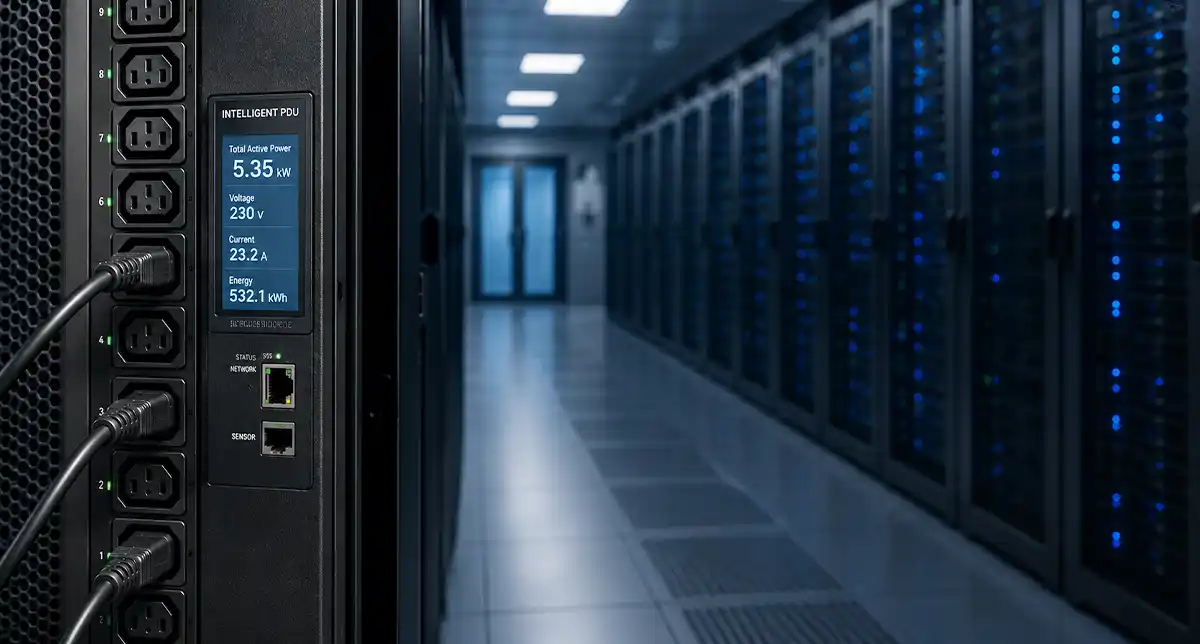
Power is a critical resource in every data centre but merely confirming that electricity reaches a rack is no longer sufficient. Operators today must know how much power each device consumes, where spare capacity exists, and whether loads are nearing their limits.
An intelligent PDU provides exactly that insight.
Unlike a basic power distribution unit (PDU), which simply delivers electricity to IT equipment, an intelligent PDU monitors consumption, communicates data, and—depending on the model—offers remote control. This transforms the PDU from a passive component into an active source of operational information.
When organisations feed that information into a broader Data Centre Infrastructure Management system such as Sensorium DCIM, they obtain a clear, real time view of power usage across racks, rooms, and entire sites. As a result, they can make better capacity planning decisions, avoid overloads, and optimise energy efficiency.
What Is a PDU?
A Power Distribution Unit (PDU) delivers electricity to servers, switches, storage devices, and other hardware inside a data centre rack.
At its core, a rack mounted PDU simply takes an incoming power feed and splits it into several outlets that the rack’s equipment can plug into.
Basic PDUs work fine for many setups, but they offer little or no insight into what happens after devices are connected.
For instance, the facilities team may know the rated capacity of the circuit feeding the rack, yet that information alone does not reveal:
- how much power the rack is actually using right now;
- whether that usage is trending upward;
- how evenly the load is spread across the available capacity;
- which racks still have unused power headroom;
- when a load is nearing a preset limit; or, in more sophisticated models, the exact consumption of each individual piece of equipment.
As rack densities climb, this lack of visibility makes managing capacity increasingly challenging.
What Makes a PDU Intelligent?
An intelligent PDU—often called an iPDU or smart PDU—adds network connectivity and monitoring to power distribution.
Depending on its specifications, it can measure voltage, current, active power, and energy consumption. Advanced models monitor each outlet individually, and switched versions let operators turn specific outlets on or off remotely.
Because of these capabilities, the data centre team no longer only asks, “Is power available at this rack?” Instead, they can ask, “How much power is this rack actually using, how is that usage changing, and how much capacity remains?”
This shift in visibility makes intelligent PDUs a valuable tool for modern data centre management.
Different Levels of Intelligent PDU Monitoring
Intelligent PDUs are not all created equal; their capabilities can be grouped into several progressive levels.
First, Overall PDU Monitoring
At this basic level, the PDU monitors the total electrical load of the rack.
Operators can see how much power the entire rack consumes without having to measure each device individually. This alone improves on a plain PDU, allowing data centre teams to watch load trends, set alert thresholds, and spot racks that are nearing their power limits.
Next, Per-Outlet Monitoring
More advanced intelligent PDUs go a step further by measuring the draw of each outlet.
This granularity lets operators pinpoint the exact power demand of individual servers or other equipment. With per-outlet data they can plan capacity more accurately and quickly uncover devices that draw power while doing little useful work.
Then, Switched Intelligent PDUs
Switched PDUs add remote outlet control. Authorised staff can turn any outlet on or off and, when procedures permit, power cycle connected equipment from afar.
When a server or network device hangs, the team can often reboot it remotely instead of dispatching a technician to the rack.
Finally, The Industry Perspective
The US ENERGY STAR program highlights that many intelligent PDUs combine remote switching with monitoring data to support capacity planning and to identify underutilised equipment.
We will examine each of these intelligent PDU types in greater depth in upcoming articles.
Why Does Intelligent PDU Monitoring Matter?
An intelligent PDU does more than just show a live current reading—it delivers actionable data that boosts data centre performance in several ways.
1. Better Power Capacity Planning
Firstly, it improves power‑capacity planning. Installed capacity often differs from available capacity. If operators rely only on name plate ratings, spreadsheets, or occasional manual checks, they can misjudge how much headroom remains.
By measuring real time draw at each rack, the intelligent PDU reveals exactly where spare capacity exists and where adding equipment might push a circuit toward overload. As a result, teams can therefore maximise the infrastructure they already own before deciding to purchase extra power.
2. Earlier Warning of Potential Problems
Secondly, it gives an early warning of emerging problems. Power draw fluctuates as new equipment is added, workloads shift, or configurations change.
Continuous PDU monitoring makes these variations visible, allowing operators to set thresholds and trigger alerts when consumption approaches preset limits. When an alert activates, staff can investigate the issue promptly, often averting a power loss or service interruption before it occurs.
3. Improved Data Centre Power Visibility
Thirdly, it enhances overall power visibility. A single intelligent PDU supplies useful metrics; hundreds of them generate a massive data set.
The challenge then becomes turning that raw information into something operational teams can use efficiently. Checking each PDU’s individual console works only for very small deployments; as the number of racks, rooms, and sites grows, that approach quickly becomes unwieldy.
Consequently, integrating the PDU data within a Data Centre Infrastructure Management system becomes essential.
4. The DCIM Benefit
DCIM aggregates the measurements, presents them in a unified dashboard, and enables automated reporting, trend analysis, and capacity planning workflows. Turning countless data points into clear, actionable insight for the entire visibility of the data centre organisation.
From Intelligent PDU Data to Data Centre Intelligence
An intelligent PDU displays power usage at the rack level, and a DCIM platform adds that data to a broader operational picture. Sensorium DCIM, for example, continuously monitors intelligent PDUs together with UPS systems, generators, and other electrical equipment. This lets operators view power information in the context of the whole data centre instead of as isolated devices.
Rather than logging into each management interface, teams can gather all relevant data in a single, unified view.
Because of this, it becomes easier to:
- Identify racks nearing their power limits.
- Spot available power capacity.
- Detect abnormal rises in consumption.
- Observe trends across different zones.
- Locate equipment or areas that need investigation.
- Prioritise alarms that require immediate attention.
More importantly, power never works in isolation.
Connecting Power and Environmental Data
Adding environmental data gives a fuller picture. Higher power density creates more heat, so knowing a rack’s power draw is far more useful when you also see temperature and other conditions around it.
By merging intelligent PDU data with iSensor environmental monitoring inside Sensorium DCIM, teams can examine how electrical load and environmental factors interact.
For instance, a rise in rack power consumption often matches higher inlet or exhaust temperatures. Viewed alone, those changes seem unrelated; viewed together through a common platform, they reveal meaningful operational context.
This insight matters most in high density environments, where even small workload shifts can cause large changes in both power demand and heat output.
Intelligent PDUs and High-Density Computing
The rapid expansion of High-Performance Computing, Artificial Intelligence, and Machine Learning makes rack level power visibility increasingly critical.
GPU intensive infrastructure now generates far higher power densities than traditional enterprise equipment. Consequently, this is prompting industry guidance to favour high capacity intelligent PDUs, fine grained power monitoring, and operation in warmer environments.
As a result, data centre operators must know not only whether overall power is sufficient, but precisely where they can install additional high density equipment without breaching electrical or thermal limits.
Intelligent PDU monitoring supplies a key piece of that information, yet its true value emerges when it is combined with data from the rest of the infrastructure. Therefore, integrating PDU insights with broader system metrics enables operators to make confident, data driven placement decisions.
Avoiding Another Data Silo
Installing intelligent PDUs alone does not guarantee intelligent power management.
When each device works in isolation, organisations merely trade missing data for a new data silo.
For instance, one interface might monitor PDU performance, another might watch UPS systems, and a third could monitor environmental conditions. Operators therefore must switch between these separate tools to piece together a complete view of what is happening.
A vendor neutral DCIM platform eliminates this fragmentation.
Sensorium gathers data from all infrastructure systems and integrates power information into the overall operational picture.
As a result, organisations do not need to standardise every rack on the same PDU manufacturer simply to obtain centralised monitoring. This flexibility proves especially valuable in mature data centres where infrastructure has evolved over many years.
Real-World Application
Sensorium has helped many organisations. Including a major UK bank, who integrate modern intelligent PDUs with their existing proprietary protocol PDUs without requiring a costly infrastructure overhaul. The bank needed a solution to bridge the two systems, and Sensorium provided one.
Consequently, the bank achieved seamless integration while preserving its current investments.
From Power Distribution to Power Management
A basic PDU simply delivers power, whereas an intelligent PDU reports what that power is doing.
This difference matters more than ever because rack densities are climbing, and data centre operators must boost capacity, keep systems resilient, and improve efficiency. To achieve these goals, they need precise, near load power data—exactly what intelligent PDUs supply at the rack level.
Yet the greatest value emerges when you fuse that rack level information with data from UPS units, environmental sensors, cooling systems, and other critical infrastructure. By integrating these sources, intelligent PDU monitoring stops being a standalone feature and becomes a core component of a comprehensive data centre power management strategy.
With Sensorium DCIM, teams can aggregate intelligent PDU metrics together with data from the entire infrastructure, creating the visibility required to make faster, better informed operational decisions.
Discover More
Discover how Sensorium DCIM can bring power, environmental and infrastructure information together within a single monitoring platform.
For our latest updates follow our company page on LinkedIn.