


Data centre infrastructure changes constantly. Organisations open new sites, bring in equipment from different vendors, add cloud services, and keep older hardware that still works.
This mix creates a hybrid data centre setup that spans locations, technologies, and management tools.
While the flexibility helps businesses grow, it also raises operational questions. For instance, how can teams monitor everything when devices speak different protocols? How do they control power, cooling, and security across many sites? And how do they make smart decisions when several providers share responsibility?
Therefore, the real problem is not just handling more gear; it is gaining a clear, consistent view of an increasingly complex environment.
What Is a Hybrid Data Centre Environment?
A hybrid data centre environment mixes different kinds of IT infrastructure to satisfy an organisation’s operational needs. This mix can include an on premises data centre, a colocation facility, remote server rooms, and cloud services. Within these environments, organisations often run equipment from several manufacturers, ranging from brand new systems to legacy equipment.
Specifically, a hybrid cloud blends on premises hardware with private and public cloud resources. Managing the physical components of a broader hybrid IT estate, however, brings unique challenges.
For instance, an organisation might operate its primary data centre, lease extra capacity from a colocation provider, and maintain smaller communications rooms in multiple offices.
Each site could use distinct power distribution equipment, cooling systems, environmental sensors, and security measures.
As the infrastructure grows, maintaining consistent operational visibility becomes increasingly difficult.
1. Maintaining Visibility Across Multiple Locations
The challenge: Different sites, different monitoring systems.
In a hybrid environment, infrastructure often spans several geographic sites, each using its own monitoring tools.
For example, one facility may rely on an established Building Management System (BMS), while another uses manufacturer specific software, and remote server rooms might offer only basic monitoring. Because operators must jump between these platforms to assess the condition of their assets, they face a fragmented view that makes it difficult to spot problems, compare performance, or determine whether an issue is isolated to a single site or affecting multiple locations.
This disjointed approach also complicates remote management efforts, as teams struggle to consolidate data and act quickly across dispersed infrastructures.
Unifying multiple sites in a single operational view
A centralised Data Centre Infrastructure Management (DCIM) platform enables organisations to see their physical infrastructure consistently.
For instance, Sensorium™ DCIM aggregates data from various sites, manufacturers, and building systems into one management environment.
Because its vendor-neutral design works with existing compatible equipment, teams don’t need to install a separate monitoring system at each location. Instead, they can use shared dashboards and reporting tools to view overall infrastructure while still drilling down into individual sites for detailed analysis.
2. Integrating Legacy and Modern Infrastructure
The challenge: Equipment does not always communicate in the same way.
Few organisations replace all their data centre infrastructure at once.
Instead, they add new hardware gradually as demand grows, technology advances, or older hardware reaches the end of their useful life. Consequently, older UPS systems, PDUs, and cooling units often run side by side with newer, intelligent devices.
However, these mixed environments frequently suffer from incompatible communication protocols—different manufacturers and equipment generations speak different “languages,” and many legacy components offer only basic monitoring.
Rather than discarding still functional equipment just to achieve software compatibility, companies should seek solutions that bridge the gap.
By doing so, they avoid unnecessary expenses and minimise operational disruption while still gaining the visibility and control needed for a modern infrastructure.
Modernising without replacing everything
A vendor neutral DCIM approach lets organisations connect equipment from many manufacturers, as long as the necessary interfaces and integration steps exist.
Sensorium™ follows this principle: its flexible communication architecture works with both modern and legacy systems, so companies can keep their current infrastructure while adding new technology.
For example, ADS assisted a UAE colocation provider in gaining power monitoring visibility without discarding its existing legacy PDUs. The project added branch circuit monitoring, fed the data into Sensorium, and allowed the provider to introduce intelligent PDUs step by step on a single, consistent monitoring platform.
3. Managing Power and Cooling Across Different Environments
The challenge: Different workloads create different infrastructure demands.
In a hybrid environment, not every component shares the same power and cooling needs.
First, traditional enterprise servers, high density computing equipment, and smaller remote installations each place different demands on the supporting infrastructure. Moreover, as workloads shift, power consumption and heat generation change over time.
Without accurate monitoring, operators struggle to tell which racks are nearing their power limits or whether cooling systems are responding effectively. Consequently, comparing infrastructure capacity across multiple sites becomes especially challenging when teams lack reliable, real time data.
Combining rack power and environmental monitoring
Effective infrastructure management requires more than an overall power reading or an average room temperature. Instead, they require detailed, real time insight at both the equipment and environment levels.
The ADS ACU iPDU family delivers exactly that through four distinct models.
The first model monitors total PDU output; the second adds per outlet readings; the third lets users switch outlets remotely; and the fourth enables programmable, sequential start up sequences. Because each tier builds on the previous one, operators can choose precisely the depth of visibility and control their installation demands.
At the same time, the iSensor Environmental Monitoring Controller tracks temperature and humidity throughout rows and cabinets, accepting up to 24 sensor pairs to pinpoint hotspots or moisture shifts.
When these two streams feed into Sensorium™, analysts can correlate spikes in rack power draw with simultaneous temperature rises—say, noting that higher inlet temps accompany increased load—and then probe airflow adequacy or cooling capacity. This fused view streamlines capacity planning and guides smarter day to day operations.
4. Maintaining Consistent Physical Security
The challenge: Access arrangements differ between facilities.
When an organisation runs infrastructure across many sites, physical security becomes more complex.
For example, an on premises facility often employs its own security staff, while a colocation provider controls access to shared areas. A remote communications room may follow a different set of rules altogether.
Even if someone gains entry to the building or data hall, that does not reveal which server rack they actually opened.
Moreover, each location may keep its own access logs, making it difficult to compile a consistent view of activity across the entire infrastructure.
Extending security to individual racks
Rack level access control delivers a more detailed level of physical security.
The iAccess Rack Access Control Controller lets organisations manage rack security and log every access attempt—both successful and failed. When it works together with Sensorium, rack access data appears alongside other infrastructure information, giving authorised teams a fuller operational view.
For example, if operators notice an unexpected equipment event, they can pull up the relevant rack access records at the same time they review power and environmental metrics.
This combined view helps them determine what occurred, when it happened, and whether they need to investigate further.
5. Establishing Clear Operational Responsibilities
The challenge: Multiple teams and providers share responsibility.
Hybrid environments often involve multiple organisations and departments.
An internal IT team manages servers and applications, facilities engineers maintain power and cooling systems, and a colocation provider controls the building services at an external site.
Although these responsibilities differ, operational events rarely respect departmental boundaries.
For instance, a cooling failure can disrupt IT equipment even though the problem originates within the facilities team’s domain.
As a result, without shared information and clearly defined procedures, teams waste valuable time determining who should respond.
Shared visibility without losing control
A unified DCIM platform gives each team the data it needs while keeping operational limits clear.
Sensorium™ creates role based dashboards so facilities engineers, IT staff, and other stakeholders can see exactly what matters to them. Moreover, having shared visibility does not grant every user full control; access stays restricted to the appropriate functions.
For instance, ADS applied this model in a UK banking project that integrated IT infrastructure with Trend controlled cooling systems yet kept the IT and facilities teams’ responsibilities separate.
Building a More Consistent Approach to Hybrid Data Centre Management
Organisations must establish consistent operational practices to manage hybrid infrastructure successfully, even when their facilities and equipment differ.
Instead of adding a separate management system each time the infrastructure grows, teams should evaluate how every new component integrates into their overall monitoring strategy.
Consequently, they need to create common approaches for power monitoring, environmental measurements, access control, alarm handling, and reporting. On the other hand, standardisation does not require identical hardware everywhere.
By adopting a vendor neutral approach, organisations can keep diverse equipment while feeding the data it generates into a single, unified operational environment.
How ADS solutions work together
A practical example of integrated physical infrastructure monitoring.
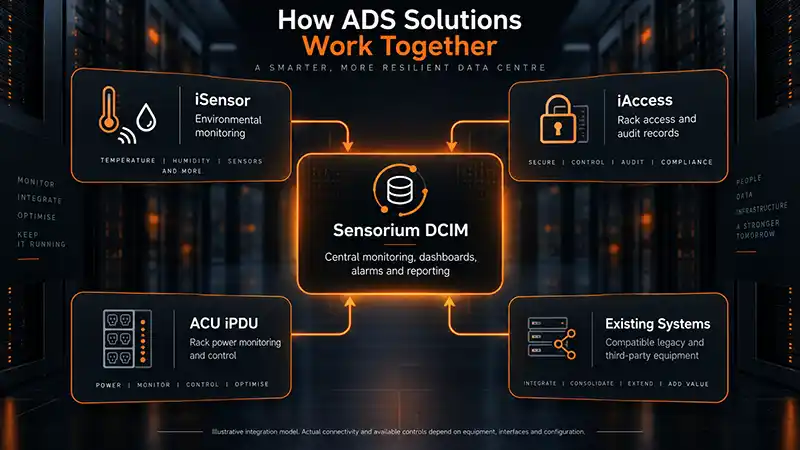
By combining these capabilities, organisations can build a more consistent approach to infrastructure management without requiring every site to use the same equipment.
Conclusion: Hybrid Infrastructure Needs Connected Thinking
Hybrid data centre environments give organisations the means to expand, modernise, and distribute their IT infrastructure more easily.
This flexibility, however, creates challenges in monitoring, integration, power management, environmental conditions, and physical security. As infrastructure spreads across more sites, maintaining consistent visibility becomes crucial.
To address this, organisations can combine vendor neutral DCIM with integrated power, environmental, and rack access monitoring.
This integration delivers a clear, real time view of the physical environment.
The aim is not to make every data centre identical, but to ensure each location contributes to a uniform, informed approach to infrastructure management.
Learn how Sensorium DCIM can unify your existing infrastructure into a single operational platform.
For our latest updates follow our company page on LinkedIn.
Frequently Asked Questions
What is a hybrid data centre?
A hybrid data centre environment blends infrastructure from different locations and deployment models—such as on‑premises facilities, colocation sites, and cloud services. Moreover, it often houses equipment from multiple manufacturers and spans several generations.
What are the main challenges of hybrid data centre management?
Common challenges include maintaining visibility across locations, integrating legacy equipment, managing different power and cooling requirements, maintaining physical security and coordinating responsibilities between teams and providers.
How does DCIM support hybrid data centre environments?
DCIM enables operators to monitor and manage their physical data centre infrastructure through centralised dashboards, real‑time alarms, and detailed reports. Additionally, vendor‑neutral platforms such as Sensorium™ can combine compatible equipment from different manufacturers across multiple locations.
Can existing equipment be integrated into a hybrid monitoring strategy?
Yes, if organisations have suitable monitoring interfaces or integration methods, they can keep their functional legacy equipment. Consequently, they can gradually introduce additional monitoring features instead of replacing the entire infrastructure.