

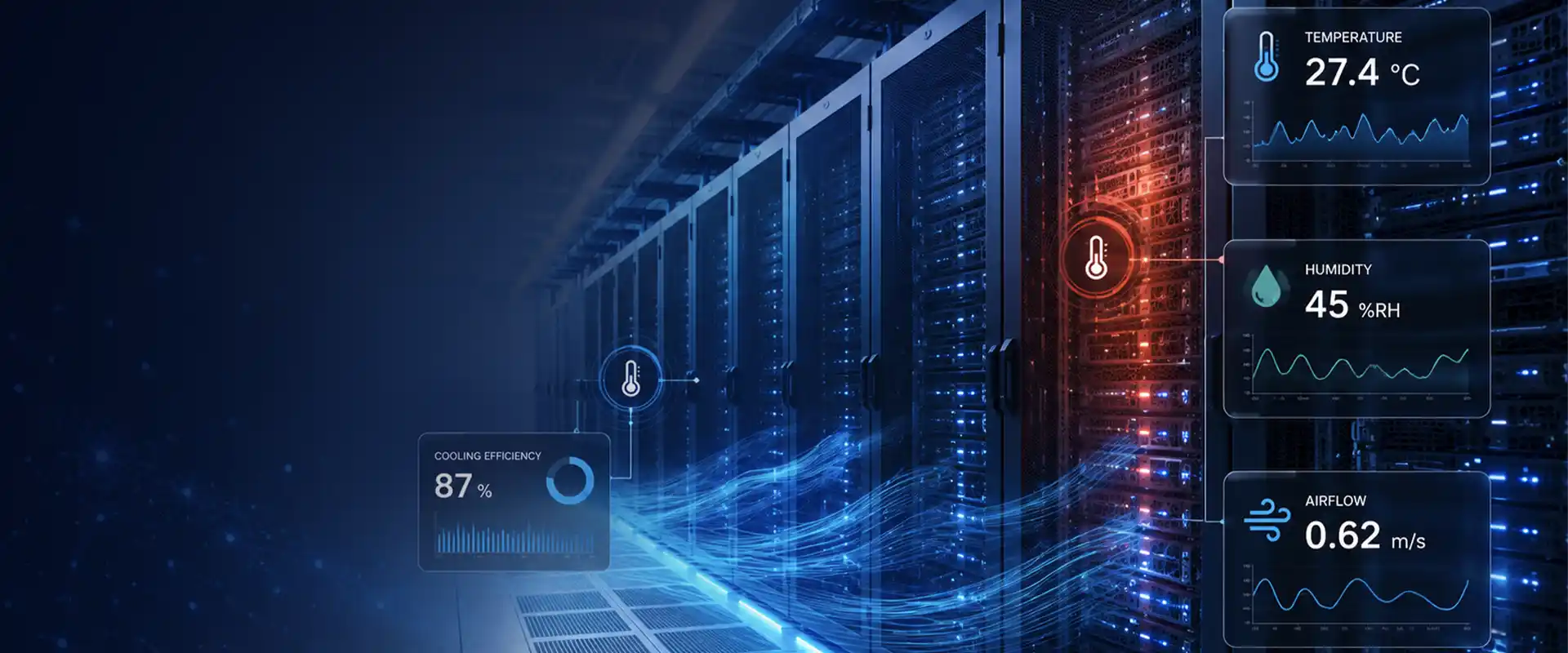
Improving cooling efficiency in data centres is vital. Cooling systems consume a massive share of energy—often 30% to 50% of total facility power. Yet many operators still manage cooling through outdated methods: periodic manual checks, fixed temperature setpoints, and limited visibility into what’s actually happening.
Here’s the core problem: you can’t improve what you don’t understand.
Real-time monitoring solves this. Continuous tracking of temperature, humidity, and airflow gives operators a clear, up-to-the-minute view of their entire environment. This visibility uncovers inefficiencies, prevents dangerous hotspots, and empowers data-driven decisions that reduce cooling costs without sacrificing reliability.
Why Cooling Efficiency Matters
Data centres produce massive amounts of heat. Every server, storage array, network switch, and power supply adds to the thermal load inside the facility.
If the cooling system can’t expel this heat efficiently, a cascade of problems can appear:
- Equipment overheating – excess heat can trigger automatic shutdowns or cause components to fail outright.
- Reduced hardware lifespan – constant thermal stress ages processors, drives, and other parts much faster.
- Increased risk of downtime – hotspots lead to unplanned outages that disrupt services.
- Higher energy consumption – fans and compressors run harder to compensate for the heat, driving up power use.
- Worse Power Usage Effectiveness (PUE) – more energy is diverted to cooling rather than computing, inflating the overall efficiency ratio.
- Surging operational costs – higher electricity bills and premature hardware replacements eat into the budget.
Many operators counter these threats by over cooling the space, maintaining a safety margin that feels secure. However, this approach often wastes energy and inflates operating expenses without delivering any real benefit.
The real objective isn’t simply to lower the temperature. The objective is to cool the data centre efficiently.
The Limitations of Traditional Cooling Management
For decades, facilities relied on a handful of sensors scattered across rooms. This sparse monitoring approach left significant blind spots in environmental oversight.
The consequences proved costly:
- Hotspots frequently emerged between sensor locations, evading detection until they escalated.
- Cooling systems often ran harder than necessary, driving up energy consumption.
- Airflow disruptions remained hidden from operators.
- Temperature variations across equipment racks routinely went unnoticed.
- Problems typically only surfaced after triggering critical system alerts.
Without comprehensive environmental data, operators found themselves making cooling decisions based on assumptions rather than actual conditions.
Real-time monitoring transforms this reactive approach into a proactive strategy.
How Real-Time Monitoring Supports Cooling Optimisation
Real-time monitoring gives operators’ constant visibility into environmental conditions throughout the data centre. Rather than relying on periodic inspections, teams can access live data the moment conditions change, allowing them to respond immediately rather than react after problems arise.
Early Detection of Hotspots
Hotspots rarely develop without notice. Temperature sensors placed at rack level detect rising temperatures well before equipment reaches critical thresholds. This early warning enables teams to:
- Investigate airflow restrictions that may be blocking cooling.
- Balance cooling loads across racks to distribute cold air effectively.
- Adjust containment strategies to maintain proper separation between hot and cold airflows.
- Prevent thermal incidents before they cause equipment failures or unplanned downtime.
Addressing these issues early helps organisations avoid expensive downtime while improving overall cooling efficiency.
Identifying Overcooled Areas
Cooling inefficiencies don’t always stem from insufficient cooling. In many facilities, certain areas receive far more cooling than they actually require. Real-time environmental monitoring systems help operators pinpoint:
- Underutilised cooling capacity where resources go to waste.
- Excessively cold zones that consume more energy than necessary.
- Uneven temperature distribution across different parts of the facility.
- Opportunities to raise cooling set points safely without risking equipment health.
Even minor adjustments in these areas can generate significant energy savings across the entire facility.
Supporting Airflow Management
Effective airflow management forms the foundation of cooling efficiency. When hot and cold air streams mix due to poor airflow, cooling effectiveness drops while energy consumption rises. Environmental monitoring helps identify:
- Airflow bottlenecks where cold air struggles to reach equipment.
- Recirculation issues where hot air returns to intake zones.
- Bypass airflow that bypasses equipment entirely.
- Containment performance problems that undermine hot or cold aisle isolation.
With accurate environmental data, operators can make targeted improvements that enhance cooling performance—often without investing in additional cooling infrastructure.
The Role of Environmental Monitoring Systems
Modern environmental monitoring solutions go far beyond just temperature readings. Advanced platforms can capture a wide range of parameters, such as:
- Temperature – ambient air and surface temperatures across the facility.
- Humidity – relative humidity and moisture levels that may affect equipment.
- Air quality – concentrations of pollutants, particulates, and gaseous contaminants.
- Differential pressure – pressure differences between rooms that indicate airflow integrity.
- Airflow conditions – velocity and direction of air movement to ensure proper cooling.
- Water leaks – detection of moisture or flooding that could damage infrastructure.
- Power related environmental events – power surges, outages, or voltage fluctuations impacting operations.
By deploying sensors throughout the data centre, operators gain a comprehensive view of environmental performance, enabling them to spot trends and respond quickly to any anomalies.
How iSensor Helps Improve Cooling Efficiency
ADS iSensor delivers live environmental insights purpose built for high availability data centres, labs, and other sensitive sites. The platform gives teams the ability to:
- Track rack level temperatures – continuously measure thermal conditions at each rack to spot heat accumulation early.
- Monitor humidity levels – capture relative humidity data across the data hall, ensuring conditions stay within safe ranges.
- Get instant alerts – receive push notifications or emails the moment any sensor breaches predefined thresholds, enabling rapid response.
- Detect emerging hotspots – use advanced analytics to identify localised heat spikes before they become larger problems.
- Build historical trends – store and visualise long term environmental data, making it easy to spot patterns and plan capacity upgrades.
- Generate compliance and optimisation reports – leverage the collected metrics to produce audit ready documentation and guide cooling efficiency initiatives.
Rather than waiting for a failure to trigger action, personnel can use the platform’s live operational data to tune cooling performance proactively, improving reliability and energy efficiency.
Why Historical Data Is Just as Important as Real-Time Data
Real time monitoring gives you instant insight, but lasting optimisation comes from looking at the past.
Historical environmental data lets operators:
- Detect recurring cooling problems – see the same trouble spots appear again and again.
- Compare seasonal performance – benchmark how equipment behaves in summer, winter, and everything in between.
- Assess the impact of infrastructure changes – evaluate what happens when you add, remove, or upgrade a component.
- Quantify airflow improvements – measure the actual cooling gain after adjusting vents, fans, or ductwork.
- Track efficiency initiatives over time – follow the progress of energy saving projects from launch to long term results.
These insights enable facilities to move from simply reacting to problems to continuously fine tuning their operation.
Where DCIM Fits Into Cooling Efficiency
Environmental monitoring delivers critical data, but Data Centre Infrastructure Management (DCIM) transforms that data into powerful operational intelligence.
A DCIM platform consolidates environmental information alongside power metrics, capacity planning data, asset details, and operational metrics into one unified management system.
Creating a Single Source of Truth
When environmental monitoring integrates with DCIM, operators gain the ability to:
- View environmental conditions and infrastructure performance side by side in a single console.
- Correlate cooling efficiency directly with IT equipment loads to identify optimisation opportunities.
- Spot inefficient rack layouts that waste energy or create hotspots.
- Track capacity utilisation across racks, rows, and the entire facility in real time.
- Analyse cooling effectiveness across the entire data centre footprint.
This comprehensive view empowers teams to make smarter, data-driven operational decisions.
Using Sensorium DCIM for Smarter Cooling Management
Sensorium DCIM helps organisations convert raw environmental data into meaningful operational insights.
When integrated with environmental monitoring devices like iSensor, Sensorium delivers:
- Real-time dashboards that display current conditions across all monitored areas.
- Trend analysis tools that reveal patterns in temperature, humidity, and power consumption over time.
- Automated alerts that notify teams immediately when conditions exceed defined thresholds.
- Visual infrastructure mapping that shows cooling performance overlaid on physical layout.
- Comprehensive reporting and analytics capabilities for both daily operations and strategic planning.
- Single-pane-of-glass monitoring that eliminates the need to switch between multiple systems.
Rather than managing cooling, power, and infrastructure as separate silos, operators now access a unified view of overall data centre performance.
Cooling Efficiency and Sustainability
Optimising cooling goes far beyond reducing costs.
In today’s business landscape, companies face mounting pressure to improve sustainability and hit ESG targets, making efficient cooling a strategic priority for reducing total energy consumption. By enhancing cooling performance, organisations unlock meaningful gains:
- Significantly reduce overall energy consumption.
- Improve Power Usage Effectiveness (PUE) metrics.
- Cut carbon emissions and shrink environmental impact.
- Accelerate sustainability and green initiative progress.
- Demonstrate operational excellence to stakeholders.
Real-time monitoring provides the actionable insights needed to achieve these goals—all while keeping systems reliable and running smoothly.
Conclusion
Boosting cooling efficiency isn’t just about installing extra cooling hardware—it demands clear visibility.
Real time monitoring lets data centre teams spot hotspots, cut waste, fine tune airflow, and base decisions on precise environmental readings.
When you pair environmental monitoring with a DCIM platform, you gain a complete picture of how your infrastructure behaves, enabling smarter cooling strategies, lower energy costs, improved PUE, and stronger operational resilience.
Tools such as iSensor and Sensorium DCIM supply the live insights needed to shift from reactive cooling management to continuous optimisation, helping data centres run more efficiently today while gearing up for tomorrow’s demands.