

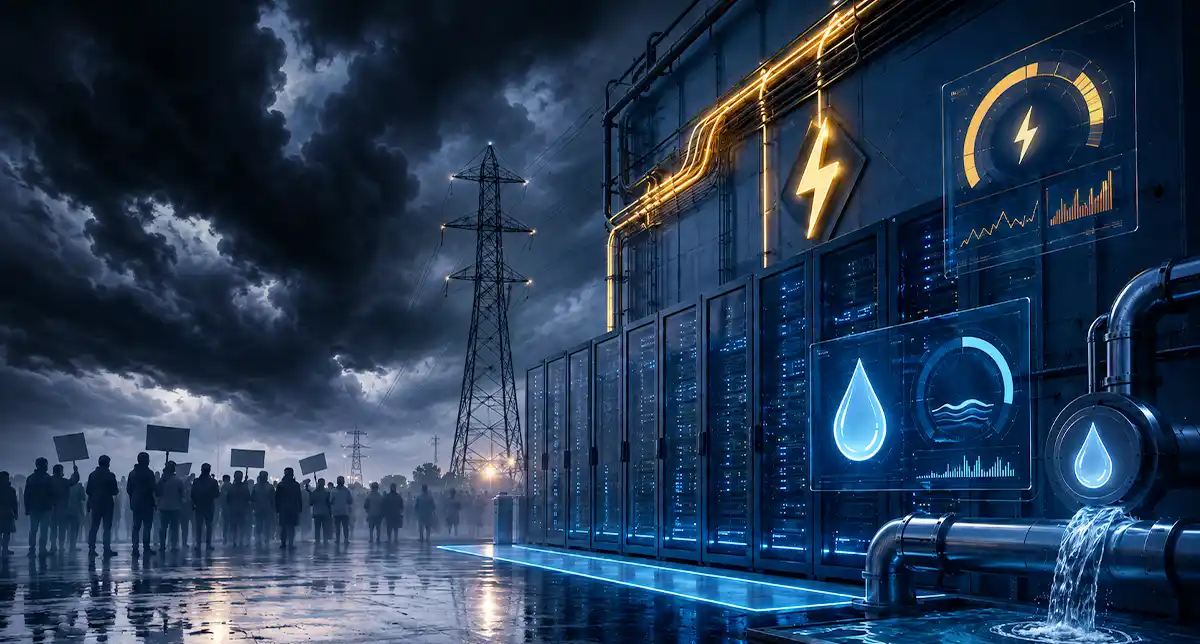
Data centres have become one of the foundations of modern society.
They support banking, healthcare, streaming, cloud computing, online retail, communications and, increasingly, artificial intelligence.
However, the public conversation around data centres is changing.
Instead of focusing on the services they enable, headlines increasingly highlight the electricity they consume, the water they require and the potential impact of continued expansion on local infrastructure.
Public opposition is growing as well.
In August 2026, a proposed 600-megawatt data centre project in Auchtertool, Scotland, reportedly attracted around 1,600 objections. Other planned developments have faced similar campaigns and protests.
This raises an uncomfortable question: has the data centre industry shot itself in the foot?
Perhaps the real issue is whether data centre growth has outpaced the sector’s ability to demonstrate that it uses power and water responsibly.
Data Centre Demand Is Growing – And So Is Scrutiny
Digital infrastructure will continue to expand.
Cloud services are growing, while artificial intelligence and high-performance computing require increasingly powerful servers. Consequently, this rising compute capacity is driving greater electricity demand.
According to the International Energy Agency (IEA), data centres consumed around 415 TWh of electricity worldwide in 2024, equivalent to approximately 1.5% of global electricity consumption. The agency expects demand to more than double to around 945 TWh by 2030, with artificial intelligence becoming a major driver of that growth.
The Local Impact of Digital Growth
However, the global figures only tell part of the story.
Data centres concentrate huge electrical loads within relatively small geographical areas. Therefore, the impact on a particular grid, community or regional infrastructure can appear much greater than the worldwide percentage suggests.
Many facilities also use water as part of their cooling infrastructure.
The UK Government’s National Framework for Water Resources notes that data centres can consume significant amounts of water. It also highlights wide variations in consumption across the sector and calls for greater transparency.
As a result, communities are asking increasingly practical questions:
- How much power and water will the facility consume?
- Where will those resources come from?
- Could the development affect local energy or water availability?
Data centre operators need credible answers to these concerns.
The Industry Needs Evidence, Not Just Sustainability Claims
For many years, facilities teams treated data centre efficiency mainly as an operational concern.
They monitored power, cooling and capacity because doing so reduced costs, protected uptime and improved infrastructure management. Historically, the wider public rarely needed to understand those figures.
That has changed.
Large data centre developments now attract local and national attention, while the rapid growth of AI has intensified the discussion.
For example, the UK Government’s criteria for proposed AI Growth Zones require applicants to demonstrate access to at least 500MW of power and sufficient water to support the infrastructure.
Therefore, power and water can no longer remain purely operational considerations. They increasingly influence conversations with planners, regulators, investors, customers and local communities.
Proving The Claims
However, claiming that a facility is efficient is not the same as proving it.
A data centre’s maximum electrical capacity does not show how much electricity it actually consumes. Likewise, the theoretical water requirement of a cooling system does not reveal its daily or seasonal usage.
Operators need accurate real-time operational data.
By measuring actual consumption, they can identify trends, demonstrate improvements and provide evidence that efficiency measures are working.
As public scrutiny increases, that evidence becomes increasingly valuable.
Power Monitoring: Understanding Where the Energy Goes
Power efficiency starts with measurement.
A facility may know how much electricity enters the building, but meaningful data centre power management requires greater visibility into how that power flows through the infrastructure.
Operators need to monitor real-time consumption across electrical distribution systems, UPS units, intelligent PDUs, racks and, where possible, individual outlets.
This creates an operational baseline.
Teams can then identify heavily loaded areas, compare actual consumption against capacity and investigate unexpected changes.
Historical data adds further context. Instead of seeing only the current load, operators can understand how consumption changes throughout the day, across workloads and over longer periods.
For example, they can assess whether infrastructure changes have reduced consumption or determine whether existing capacity is being used effectively.
As a result, power monitoring moves beyond simple metering and becomes actionable intelligence.
Data Centre Water Consumption Needs the Same Visibility
Power has traditionally received more attention because operators can usually measure it relatively easily.
However, water deserves the same visibility.
Cooling design has a significant influence on data centre water consumption, while location, climate, cooling technology and operating strategy can all affect the final figure.
Therefore, simply describing a data centre as “water intensive” can be misleading.
A more useful question is:
How much water does this specific data centre actually consume, and how can that consumption be optimised?
Integrating Water Data for Clearer Insights
By connecting compatible water meters to a central monitoring platform, operators can continuously monitor consumption in real-time rather than relying solely on periodic utility readings.
They can track trends, identify unusual increases and compare usage over time.
More importantly, they can view water consumption alongside other operational data.
For example, comparing water use with data centre cooling performance, environmental conditions and IT load can help operators understand what is driving consumption and whether efficiency initiatives are achieving the desired result.
This gives data centre teams far greater insight than viewing each resource independently.
Beyond PUE: Bringing Water into the Efficiency Conversation
Power Usage Effectiveness, or PUE, remains one of the best-known measures of data centre efficiency.
However, power represents only part of the resource-efficiency picture.
Water Usage Effectiveness, or WUE, provides another way to assess the resources required to support IT infrastructure.
As concerns around water availability increase, monitoring water consumption alongside power is likely to become increasingly important.
However, both metrics depend on accurate and consistent data.
Without reliable measurements, operators cannot establish meaningful baselines, monitor trends or demonstrate improvement.
How Sensorium™ Can Bring Power and Water Data Together
This is where Data Centre Infrastructure Management (DCIM) can play an important role.
Sensorium™ DCIM provides a vendor-neutral platform that brings operational information from multiple systems into a single management environment.
For power infrastructure, Sensorium™ can collect real-time information from intelligent PDUs, UPS units, electrical distribution equipment and other monitored devices. Operators can instantly view current consumption alongside historical trends and related infrastructure information.
However, the same approach can extend beyond electricity.
Sensorium™ can also integrate real-time data from compatible water meters and Building Management Systems (BMS), allowing operators to view water consumption alongside power, cooling, environmental and capacity data.
This removes data silos and the need to manage each resource in isolation.
Instead, operators gain a more complete picture of how the facility performs and how different systems interact.
By bringing these systems together, Sensorium™ can help teams identify inefficiencies, support sustainability reporting, monitor efficiency targets and demonstrate measurable improvements in resource use.
So, Have Data Centres Shot Themselves in the Foot?
Not necessarily.
The growth of data centre capacity reflects society’s growing demand for digital services. Every cloud application, streaming platform, online transaction and AI workload must operate somewhere.
However, the industry may have underestimated how quickly public perception would change as facilities became larger and their demands on power and water became more visible.
That creates both a challenge and an opportunity.
Efficient resource use is becoming more than an operational or cost-saving issue. Increasingly, it forms part of the industry’s social licence to operate.
Data centre operators can either allow others to define the story around their resource consumption, or they can produce the evidence needed to demonstrate responsible operation.
The first step is simple:
Measure it. Understand it. Improve it. Prove it.
By monitoring power, water, cooling and environmental conditions in real-time, operators can replace assumptions with measurable performance data.
As public scrutiny continues to grow, transparency may become just as important as efficiency itself.
For our latest updates follow our company page on LinkedIn.
Frequently Asked Questions (FAQs)
Why do data centres use so much electricity?
Servers, storage, networking equipment and supporting infrastructure all require electricity. Cooling systems, UPS units, pumps and other equipment add further demand. In addition, AI and high-performance computing are increasing power densities, making energy efficiency even more important.
Why do data centres consume water?
Some cooling systems use water to remove heat from IT infrastructure. However, consumption varies significantly depending on cooling technology, local climate, facility design and operating strategy.
Can DCIM monitor data centre water consumption?
Yes, where suitable meters and communication interfaces are available. A vendor-neutral platform such as Sensorium™ can integrate, in real-time, compatible water-meter information alongside power, cooling and environmental data, giving operators a broader view of facility resource consumption.
How can monitoring improve data centre efficiency?
Continuous real-time monitoring creates a reliable performance baseline. Operators can compare current and historical consumption, identify unexpected changes and measure the effect of efficiency initiatives. As a result, raw data becomes actionable information that supports better operational decisions.